
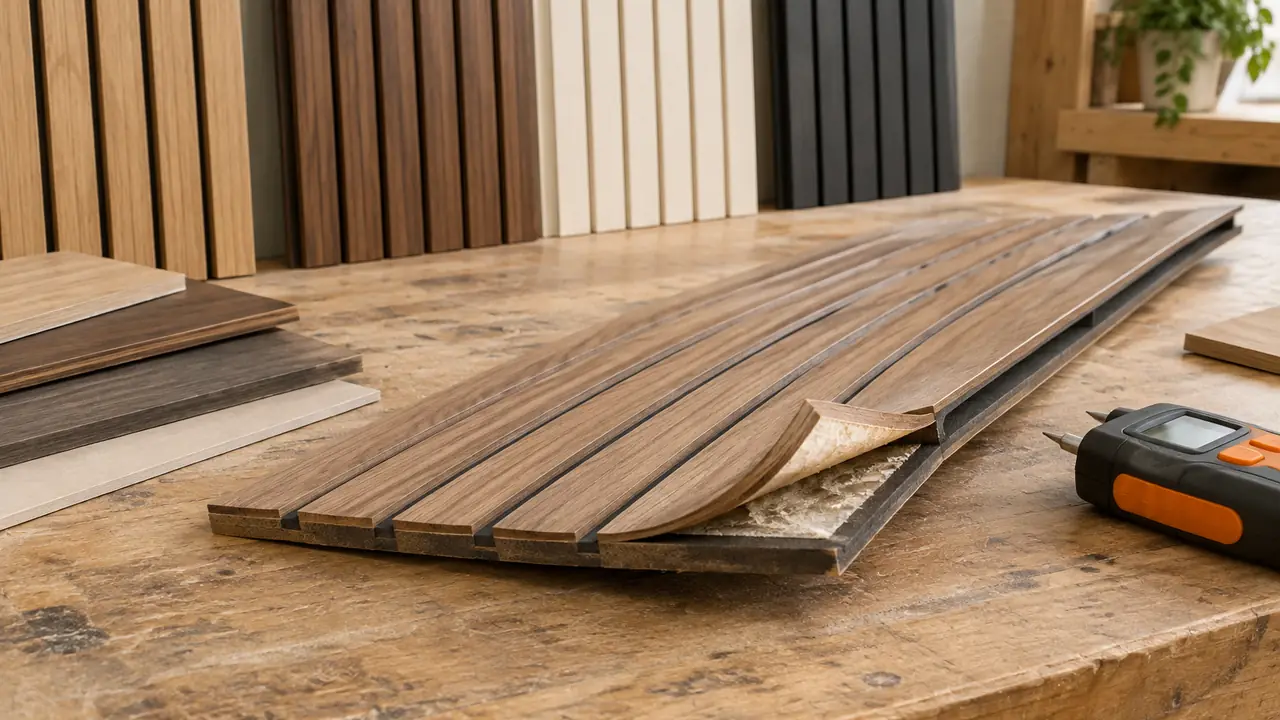
Four interfaces, one symptom
Delamination complaints arrive as one symptom - a slat hanging loose, a felt corner lifting, a hollow patch behind a surface that used to feel solid - but a slat panel has four distinct interfaces where separation can begin: the bond between slat and felt, the internal structure of the felt itself, the joint between felt and whatever holds the panel to the wall, and the classic face-to-core bond on the slat material itself. Each has a different cause, a different guilty party and a different check, which is why the first question after any delamination photograph is not "why" but "which layer". Programs that identify the interface settle claims in one exchange; programs that do not argue in circles.
The stakes are higher than on a plain decorative panel, for one specific reason: an acoustic panel's published absorption figure assumes its geometry and its layers are intact. Slat panels with PET felt commonly publish NRC values in the 0.75-0.85 band per ASTM C423 or ISO 354, and that number belongs to a tested configuration - open gaps, felt of a stated thickness and density, a cavity as tested. A panel whose felt has let go no longer matches any tested build-up. The NRC note explains the claim; this note explains the failure modes behind it.
First cause: the slat-to-felt bond line
The most frequent origin is the joint the panel is named for: slats bonded to felt at the production line. The process is usually adhesive applied in beads or films, slats laid at pitch, press or roller to set - and its failure modes are coverage gaps, adhesive that has skinned before lay-up, or pressure that never reached the middle of a wide panel. Coverage gaps matter more here than almost anywhere else in panel making, because the gap shows itself as one loose slat among a hundred good ones, at a height where a hand finds it. A production line drifting on adhesive metering produces a lot where most panels are fine and a few are not, which is the worst distribution a brand can ship.
The defense is a named test in the inspection plan: a pull or peel check on sampled slats per lot, agreed before production with a written threshold. It takes minutes, damages a sample panel rather than a wall, and catches a drifting line at the lot where it drifted. This is a standing item in the plans the desk coordinates through the testing and inspection page, and it is the least expensive delamination prevention a program can buy.
Second cause: the felt itself
Second is internal: the PET felt backing - commonly recycled polyester, commonly 9-12 mm thick - is itself a bonded structure of fibers and binder, and felt made with under-bonded fiber or inconsistent density can shed, crumble or separate in layer-lets under handling. The buyer cannot see this from a photograph of a swatch; it shows up as surface fuzz in the carton, dust in the box, or a felt that tears across its thickness instead of cutting cleanly. The felt backing page covers what a plant can document - recycled content, density declarations, thickness - and the honest question to ask is whether the felt in the panel is the same felt the test report describes.
Two practical checks protect a program here. First, a specification line that names felt thickness and requires the plant's material declaration, so substitutions are visible. Second, a handling check at inspection: cut a sample and look at the section, feel the surface for shedding, weigh against the declaration. Neither requires a laboratory; both require someone to agree in advance that they will be done.
Third and fourth: the wall joint and the core
Third is the joint between panel and wall, and here the installation method shares fault with the product. Felt is a porous, fibrous surface, and not every wall adhesive grips it well; an adhesive incompatible with polyester fiber can bond the carton better than the panel. Covers, clips and rails - the routes compared on the mounting system page and in the fasteners note - carry load through the panel body rather than asking glue to hold felt fibers, which is why the desk prefers mechanical fixing for felt-backed panels on commercial walls. Where adhesive is the chosen route, the install sheet should name adhesives the plant recognizes, and the tested cavity detail should be respected if an absorption figure is in play.
Fourth, least common: the slat material's own face-to-core bond, the same story the veneer peeling note tells for flat panels - press discipline and adhesive spread. On slat panels it usually announces itself as wrap or face lifting on individual strips rather than whole-panel delamination, which is a useful clue when reading a claim photograph.
The interfaces side by side
| Interface | Failure signature | Prevention in the program | Check that catches it |
|---|---|---|---|
| Slat to felt | Single loose slats; hollow rattle | Adhesive metering discipline; sampling plan | Pull or peel test per lot with a written threshold |
| Felt itself | Shedding, dust in carton, tearing across thickness | Named felt thickness and material declaration | Section cut and handling check at inspection |
| Felt to wall | Panel held by screws but felt sagging off adhesive | Mechanical fixing on commercial walls; named adhesives | Install sheet acknowledgment; site mockup |
| Face to core on slats | Wrap or face lifting on individual strips | Press process records from the slat line | Adhesion sampling as for flat panels |
What delamination risk means for a brand
For an importer, delamination is disproportionately a marketplace review risk, because it shows in photographs: one proud slat sticking out of an otherwise handsome wall says "cheap product" louder than any spec sheet can answer. The commercial defenses are structural. Spare ratio: a small overage of panels per color turns a loose-slat repair into a swap. Packaging: stack points that crush felt in transit create failures that look like bond failures, so the crate plan matters - the shipping damage note covers the stacking logic. And claim documentation: inspection records that name the pull test, the felt declaration and the packaging check turn a dispute about workmanship into a filed report with a number in it.
There is also a specification subtlety worth naming: absorption and bond quality travel together in the buyer's mind. A program that publishes an NRC figure per test report and then ships panels whose felt does not match the report's description has a claim it will lose regardless of which layer parted. Keeping the felt spec, the test report and the lot records in one file is what makes the published number defensible - the felt comparison note frames the material choices behind it.
Specification and inspection: writing the layers down
The closing program lines are four sentences. Specification: slat material and finish, felt thickness with material declaration, fixing route named - mechanical preferred where walls allow - and the absorption figure quoted only with its test report. Inspection: slat pull or peel sampling per lot against a written threshold, felt section and handling check, packaging stack points verified against the crate plan, records filed with the lot. Written into the order, those sentences make delamination a measurable property rather than a photograph, and they give both parties a shared definition of "intact" before anything ships.
The desk coordinates exactly this package when shortlisting plants for slat programs: reference quantities and production windows sit on the MOQ and lead time page, and the quote form captures felt spec, fixing route and the certificates a listing will name in the same structured message as color and area.