
What NRC actually measures
In North America, NRC is measured to ASTM C423: absorption coefficients are taken in a reverberation room across the mid frequencies where speech lives, then averaged and rounded into a single figure per the standard. In Europe the same physics runs under ISO 354 and is reported as alpha-w, a weighted single value with its own categories. Both describe absorption - how much sound energy a surface takes out of the room it faces - which is a different property from insulation between rooms. A decorative wall panel is an absorber of room sound, not a partition, and quoting it as if it blocked neighbors noise is the first misread to avoid.
Because the measurement happens in a room, the room participates in the result. The panel is mounted in the test as it is intended to be installed: with a stated backing, a stated cavity and a stated fixing method. Change any of those inputs and the laboratory is, in effect, measuring a different product. That is why a serious sheet names the configuration next to the number, and why the desk asks for the configuration before asking for the number.
Why the same slat panel can carry different values
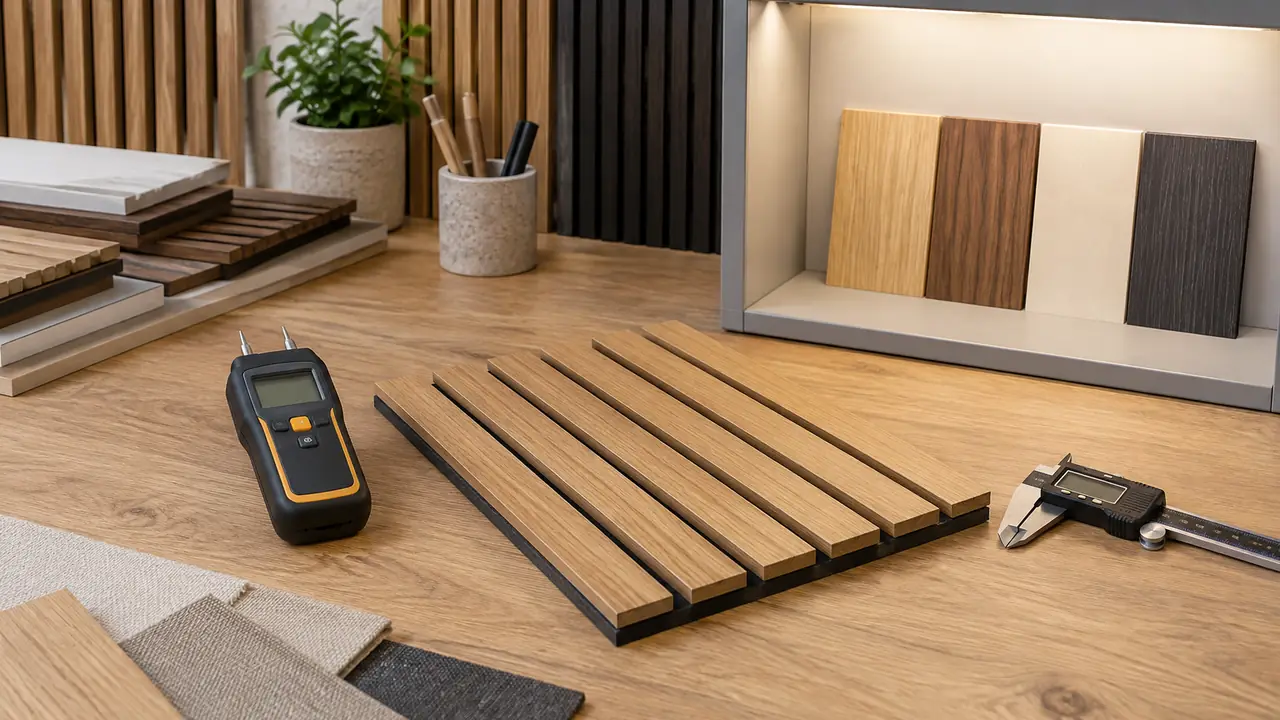
A slat panel earns its rating as a system, not as a face. The machined or fixed slats set how much open area sound passes through; the felt behind does the absorbing; the gap between panel and wall tunes the low end; the mounting system holds the cavity depth; and the coverage pattern - full wall or partial bands - decides how much of the room the system touches. Two orders of the same panel, one on battens with a deep cavity and one glued flat to masonry, will not behave the same, and no honest specification pretends they will.
| Element of the configuration | What it contributes to the result |
|---|---|
| Slat face | Sets the open area through which sound reaches the absorbing layer behind |
| PET felt backing, typically 9-12 mm | The main absorbing layer; usually recycled PET felt declared by the plant |
| Cavity or air gap | Tunes absorption toward lower frequencies behind the slats |
| Mounting system | Battens or rails hold the cavity depth the test assumed |
| Coverage pattern | Full walls and partial bands change the room-level outcome |
| The room itself | Floor, ceiling and glazing decide how much absorption the wall must add |
For these reasons the value on the sheet travels with a drawing. When a supplier hands over a figure without the mounting detail, the figure is decoration; when the report names felt thickness, cavity and fixing, it becomes a specification you can hold the wall to at inspection.
Reading the 0.75-0.85 band honestly
Slat panels with a PET felt backing commonly publish NRC values in the 0.75-0.85 band per test report, and for speech comfort in offices, restaurants and living spaces that band is a useful target. Read qualitatively, a surface at the upper end of the band takes most of the incident sound energy in the measured bands out of play, which is what shortens reverberation and lowers the clutter of voices in a busy room. What the number does not promise is a quiet building: absorption inside a room does not stop sound traveling through walls, ceilings or floors, and it does not replace partitions where partitions are needed.
The practical discipline is simple. Anchor the 0.75-0.85 band to a named configuration - slat panel, felt thickness, cavity, mounting - and ask that the report cover that build-up. Certificates and reports belong to the partner plant and the production lot, not to the brand listing, so the desk requests the document per project and keeps it with the order file. The acoustic slat panel line carries its reference band this way, per report.
Alpha-w and NRC: do not mix the numbers
Buyers working across markets meet both values and sometimes see them quoted side by side as if they were interchangeable. They are not. ASTM C423 and ISO 354 are different standards measured in different rooms with different rounding and reporting conventions, and alpha-w is presented as a weighted value in categories. A panel tested once under each standard will produce two related but distinct figures, and neither is a translation of the other. When quotes arrive from plants serving different markets, ask each one to state the standard, the configuration and the laboratory, and where a project truly depends on the value, arrange for the same build-up to be tested under the standard the project names. That is a normal request, and plants that serve hospitality buyers expect it.
Matching absorption to the room
Absorption is a budget, and the wall is only part of the account. Hard floors and glass push a room toward reflective; carpet and curtains move it back; the panel wall covers part of the gap. In offices, meeting rooms and open work areas are the usual targets, and the office fit-out note shows where coverage pays for itself. In restaurants, the aim is speech comfort at busy hours, which usually means covering the reflective surfaces nearest the tables rather than chasing a single high value. In screening rooms and home cinemas, absorption works alongside planning of first reflections, which the home theater note walks through.
Coverage is the lever most buyers under-use. A full wall of slat panel is a look; two or three strategically placed bands can deliver much of the comfort while leaving wall for joinery and services. The felt behind the slats is specified separately on the acoustic felt backing line, and its thickness enters the tested configuration, so changes there are changes to the rating as well as to the budget.
What the desk puts in writing
An acoustic order carries three documents by default: the test report for the exact configuration, with felt thickness and mounting named; the felt specification with its material declaration; and the installation detail that reproduces the tested cavity. Samples are approved against a retained swatch so the production lot can be compared under the same lamp, and inspection includes color and batch consistency along with the agreed dimensional checks. Reference quantities stay as ranges: acoustic slat programs commonly start around 100-200 square metres per color, with production in the 25-45 day band for veneer families, all confirmed in writing per order on the MOQ and lead time page. When the choice is between a fluted look and a rated acoustic build-up, the comparison note lays out the trade; to start a program, the quote form collects the room, the coverage and the market in one pass.