
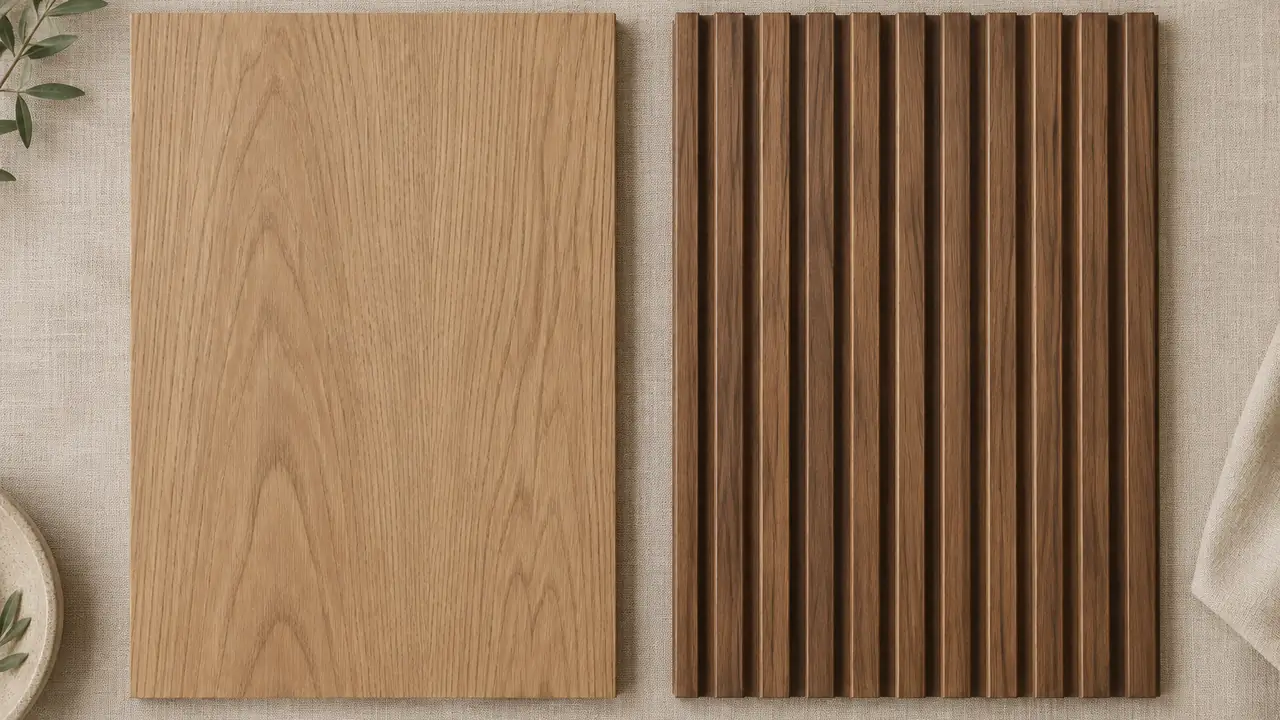
One silhouette, two different briefs
Fluted and acoustic slat panels are the pair buyers most often quote as one product, and the confusion is expensive at sampling stage: a brief asks for the acoustic version, the approved drawing shows a machined face with no felt behind it, and a production cycle is spent discovering the gap. Both products are vertical wood rhythm in similar formats - commonly 2400-2900 x 120-160 mm at 12-22 mm overall thickness, with strips 12-30 mm wide and 15-40 mm apart, finished in oak, walnut or black walnut tones. Both photograph well behind a sofa, a reception counter or a bed head. What separates them is what sits behind the rhythm, and whether a test report travels with the wall or not.
This note compares the two the way a buyer decides: construction first, then the sound question, then cost drivers without prices, then the order shape each line implies. The lines themselves are documented on the fluted panel page and the acoustic slat panel page, and the same parameters apply across partner plants with plant-specific tooling.
Construction: machined body versus strips over felt
A fluted panel is machined from one body, typically MDF: the face is routed into a continuous sequence of flutes, then veneered or wrapped so the profile reads as solid timber. The surface between flutes is continuous. There are no gaps that see the wall behind, no felt required for the panel to hold together, and dust has nowhere to settle. That continuity is the fluted panel's character in corridors and retail, where a wall is wiped as one surface and raking light would expose any wobble in a separately applied strip.
An acoustic slat panel is assembled: separate wood-look strips are fixed at pitch onto a PET felt backing, commonly recycled and commonly 9-12 mm thick. The gaps between slats stay open and the felt shows through. Those openings are functional rather than stylistic: they let sound reach the absorptive layer, which is why a slat wall manages echo while a fluted wall without a felt layer mostly decorates it. Pitch consistency across adjacent panels matters on both lines; on the slat line, felt thickness and density join the checklist, because they decide both the acoustic figure and the freight profile.
The spec lines side by side
| Aspect | Fluted panel | Acoustic slat panel |
|---|---|---|
| Construction | Profile machined into one continuous MDF body | Strips fixed at pitch onto PET felt 9-12 mm |
| Surface | Continuous; no open gaps | Open gaps; felt visible between slats |
| Acoustic role | Decorative unless felt is built in; any figure per test report | Primary purpose; NRC 0.75-0.85 band per report |
| Typical formats | 2400-2900 x 120-160 mm; 12-22 mm thick | Similar formats per spec sheet |
| Cost drivers | Face wrap or veneer, pitch tooling, thickness | Felt thickness and density, strip finish, pitch |
| Reference minimum | 100-300 sq m per color | About 100-200 sq m per color |
| Strongest fit | Feature walls where the eye leads and cleaning matters | Offices, hotels, media rooms where echo matters |
Treat the table as a frame for questions, not as a data sheet. The ranges are typical across the category, the spec sheet of the actual lot is the authority, and the desk confirms both lines' parameters in writing per program before any color is frozen.
Sound: the felt carries it, the report proves it
Absorption happens when sound enters a porous layer and leaves as heat. The slats shape the flow; the felt does the absorbing. That is why the honest question about any slat listing is not the name of the rhythm but the thickness and identity of the felt and the configuration the test measured. Slat panels with PET felt commonly publish NRC values in the 0.75-0.85 band, measured to ASTM C423 or ISO 354, and the number belongs to the tested build-up - slat pitch, felt, cavity behind - not to the family name. Two listings can both say acoustic slat and behave differently in a room if one leaves the cavity the test assumed and the other glues flat to drywall.
A fluted panel can be made absorptive by adding felt behind the machined body, and some builds do exactly that; without it, treat the fluted wall as decorative and place absorption where the room needs it. The NRC guide walks the claim in detail, and the felt backing page covers grades and recycled-content documentation a plant can put behind the material.
Cost drivers and order shape
Neither line sells on a single number; each spends budget in different places. On the fluted line the drivers are the face - a wrap, an engineered veneer or a natural veneer - plus pitch tooling and overall thickness, because thicker bodies cost more to machine and to ship. On the slat line the felt joins the list, and its thickness and density move both performance and freight: felt-backed panels pack thicker and fill a container faster, which is why the backing decision belongs in the first quotation rather than the last email before loading.
Reference minimums across the category run about 100-300 sq m per color for veneered profile lines and near 100-200 sq m for acoustic slat programs, always confirmed in writing per order. Sampling discipline is the same on both lines: a color card in 5-10 working days, panel samples in 7-15, custom colors longer because a proofing cycle comes first. Production for veneered lines typically runs 25-45 days, and inspection against the retained swatch is what keeps the two lines looking like one program when they ship together.
Which line to launch
The decision reduces to one question per wall: does sound have a job to do here? Meeting rooms, restaurants, open corridors and media walls argue for the slat line with a documented felt and a test report the listing can cite. Feature walls, brand backdrops and bedroom statements where a continuous, wipeable surface matters argue for the fluted line. Multi-room programs commonly run both - slat where people gather, flute where eyes lead - matched from one color ladder so the walls read as a single brand decision. Fixing routes are shared, and the installation systems guide covers battens, rails and adhesive for either line.
To put either program in front of two or three partner plants with one brief, the quote form takes family, area, colors and certificates in a single message; reference quantities and production windows are listed on the MOQ and lead time page, and the desk returns plant options with a realistic schedule for each line.