
Why this comparison reaches the desk
Both materials absorb sound, both appear in acoustic conversations, and both are honest products - which is exactly why the comparison confuses buyers. The resolution is positional, not competitive. PET felt is the exposed, decorative, factory-bonded backing that slat panels ship with: it is part of the product, visible in the gaps between strips, cut and colored for the catalog. Mineral wool is a high-density absorber that usually lives inside cavities or behind perforated facings in engineered acoustic constructions, specified by acoustic consultants rather than by panel plants. In most decorative wall programs the two materials never occupy the same layer, and understanding which layer a brief is actually about settles the choice faster than any datasheet comparison.
What PET felt brings to a slat panel
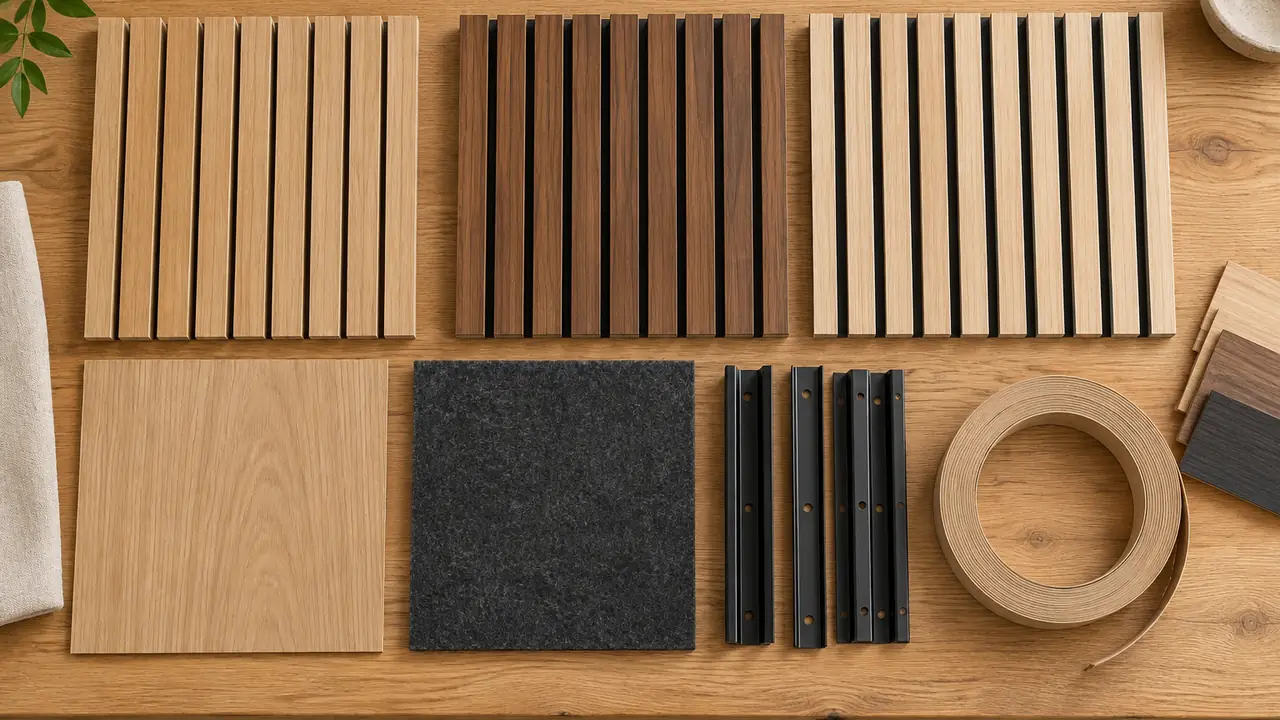
PET felt - needle-punched polyester, typically recycled, commonly 9-12 mm thick on export slat panels - was adopted by decorative panel makers because it solves several problems at once. It cuts cleanly at panel edges without shedding. Color runs through the sheet, so the gaps between slats read as one calm field and site cuts stay presentable. It is light for its thickness, which keeps wall loads, ceilings and freight all sensible. And it bonds reliably in factory lamination, surviving cartons, clamps and stairwells between the press and the wall. Its absorption contribution is real and belongs to the tested configuration: slat panels with PET felt commonly publish NRC values in the 0.75-0.85 band per ASTM C423 or ISO 354, for the exact build that was tested. The felt backing line lists the spec lines a buyer can confirm.
What mineral wool brings to a build
Mineral wool - stone or glass fibers bonded into boards and rolls - is the absorber of choice in engineered acoustic construction: studio builds, plant rooms, cinema walls, project ceilings with computed targets. It is dense, dimensionally stable, and it participates in fire-tested build-ups carrying ASTM E84 or EN 13501-1 classes per test report. What it is not, in decorative wall programs, is an exposed surface. Bare mineral wool sheds fibers, needs covered edges and protection, and would not survive a carton, a container and an installer's hands the way a bonded PET sheet does. In practice it appears behind the decorative layer - infilling the cavity behind slats on project work, or forming the core of perforated acoustic boards - and it arrives as part of a wider package with its own drawings and reports, not as a panel accessory ordered by the carton.
| Aspect | PET felt backing | Mineral wool |
|---|---|---|
| Typical position | Exposed backing bonded to slat panels | In cavities or behind perforated facings |
| Weight at panel scale | Light; freight and ceilings stay easy | Heavier; support is designed in |
| Handling | Cuts cleanly, carton-tough | Gloves and covering; not an exposed face |
| Absorption evidence | NRC per report for the tested slat build | Part of engineered build-ups, per report |
| Fire documents | Where listed, per tested build-up | Commonly cited in project specs, per report |
| Buyer who meets it | Catalog and e-commerce programs | Acoustic consultants, project packages |
Where each belongs in a program
For most catalog, marketplace and e-commerce programs the answer is simply PET felt: it is what decorative slat panels ship with, it photographs well, it installs fast, and it carries the test-backed absorption figures a listing can defend. Mineral wool enters when a project's acoustic specification demands it - a meeting-room wall with a computed target, a music room, a hotel ballroom - and then it arrives as part of a system: decorative slats or perforated facings over it, the cavity built to the specification, the reports matching the build as installed. The desk coordinates both worlds because they usually come from different partner plants: decorative panel lines and engineered acoustic packages are separate specialisms, and the components hub shows how the parts separate. A program can use both - felt-backed slats in the public areas of a venue, an engineered package in the one room where a target exists - without contradiction, because each layer is doing the job its position requires.
Claims discipline for both materials
Two rules keep this comparison honest on either side. First, absorption numbers travel with test reports for the tested configuration - never as a property of the material name; the NRC guide explains how to read the figure and what questions keep it defensible. Second, fire classes belong to tested build-ups per ASTM E84 or EN 13501-1 reports, and no material in this note is described as fireproof. Health claims are equally off the table for both: felt and mineral wool manage sound mechanically, and this desk describes them no other way. Where a listing wants to say more, it says it with a document - a declaration for recycled content, a report for absorption, a certificate for a fire class - and stays silent where the paper ends.
Practical selection questions
Three questions sort most briefs. Is the panel decorative-first, with absorption as a valuable bonus? Then PET felt on the panel, with the report that matches the build. Does an acoustic specification exist with a computed target? Then the consultant's build leads, and the decorative layer is chosen to sit over it - which may still be felt-backed slats, now installed to the specified cavity. Who installs and who maintains? Carton-tough felt favors retail channels and e-commerce logistics, where panels travel unsupervised; engineered packages favor supervised project sites with a contractor who reads drawings. The PET felt versus MDF note covers the other common fork in backing choice, and the NRC explainer turns the numbers into plain English for teams that do not read acoustics daily.
What to confirm in writing
For a PET-backed program: felt thickness and density per the spec sheet; recycled content as a plant declaration with documents; and absorption cited from the test report for the exact build being shipped. For a mineral-wool package: the acoustic specification itself, the build-up drawing, and the reports that cover it - coordinated with the decorative panel order so deliveries match the site sequence. Reference minimums for slat programs start around 100-200 square meters per color across the category, confirmed in writing per program on the MOQ and lead time page; the quote form takes either brief, and partner plants answer in the language of their own specialism. One comparison, one rule: name the layer, name the report, and the choice makes itself.