
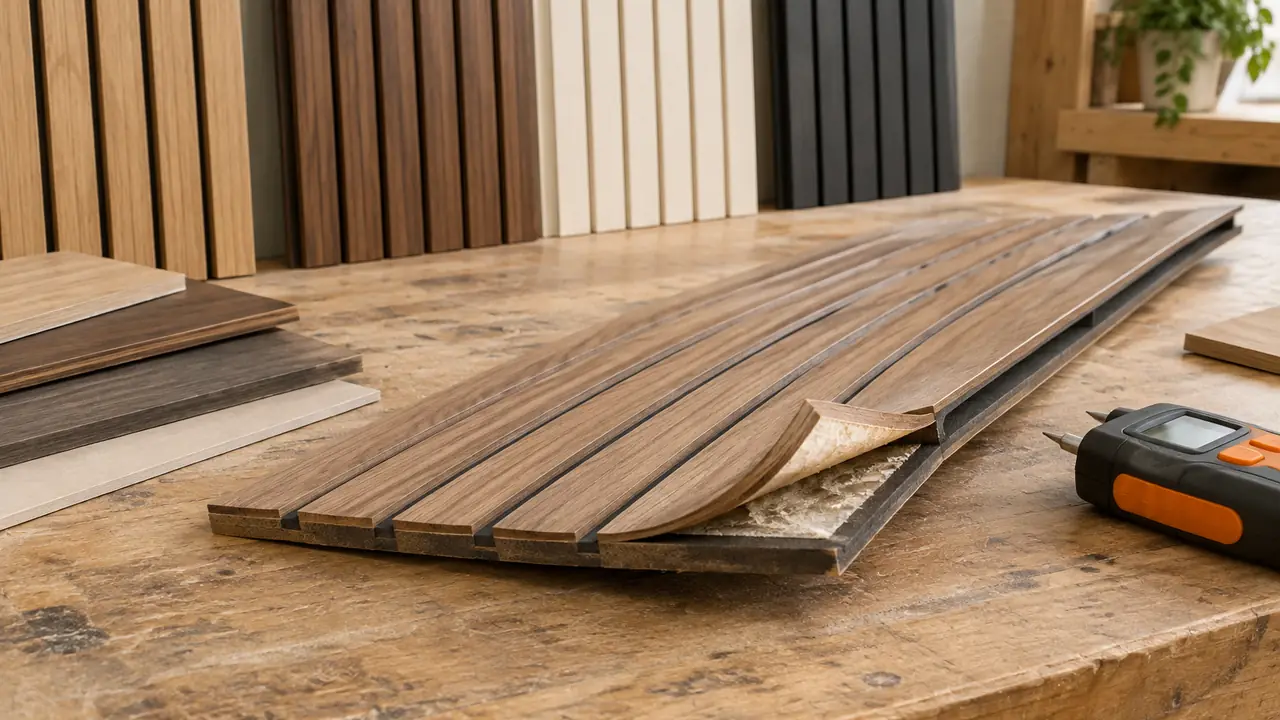
Peeling is a bond-line story
A decorative veneer panel is a marriage between a thin wood face - natural or engineered, sliced at roughly 0.3-0.6 mm - and an engineered core of MDF or plywood. The marriage lives or dies in a layer thinner than a millimeter, which is why peeling is so unsatisfying to diagnose after the fact: by the time a bubble or a lifted corner is visible, three or four candidate causes are all plausible. The productive way through is to rank them by frequency, assign each to a decision the program controls, and then put the corresponding checks into the inspection plan before production, not after a claim.
One distinction sharpens the whole conversation. Peeling - the face separating from the core over an area - is different from edge damage, where a knock opens a corner. Both trace to the bond line in the end, but the first is a production question and the second is a handling and edge-sealing question. Programs that confuse the two argue with the wrong party: blaming a plant for an impact, or a warehouse for a press fault. The ranking below keeps them separate.
First cause: press discipline and adhesive spread
The most frequent origin is at the press. Bonding a veneer to a core is a controlled sequence - adhesive metered across the surface, lay-up within the glue's open time, pressure and temperature held for the full cycle - and each step has a failure mode that shows up later as a blister, a hollow-sounding patch or a face that lifts when the room heats up. Spread that misses a strip, lay-up that waits too long, pressure released early on a thick stack: none of these are visible in the finished panel as it leaves the line. The face looks perfect in the carton. The evidence appears weeks later, in a heated room, as a bubble the size of a palm.
What a buyer can do about a step they will never watch is to make the plant prove the process. Partner plants with routine adhesion testing - a cross-cut and pull or tape method agreed in advance - catch a drifting press before a container catches it. The desk asks for exactly that in the inspection plan, and the quality control page shows how the gates are organized so a bond problem surfaces at half production, when it is a correction, rather than at final inspection, when it is a claim.
Second cause: the adhesive system itself
Not all glue is one glue. Most decorative panel work runs on E0/E1 urea-formaldehyde systems, which are proven, certified against emission grades and economical; some builds specify PUR adhesive, which bonds harder and shrugs off moisture swings better, at a cost. Where a program serves a humid climate, a kitchen-adjacent wall or a space with big seasonal temperature swings, the adhesive choice is a genuine specification decision - the adhesives note compares the families. A listing that never names the glue system is asking the buyer to inherit that decision blind.
The adhesive choice also touches compliance in the same sentence. Emission grades - E0/E1 under GB/T 39600, or CARB Phase 2 alignment with EPA TSCA Title VI for the United States - are properties of the resin in the core and the bond line, certified per lot by third parties. So the glue file a program keeps serves two purposes at once: it documents the mechanical choice, and it feeds the certificate trail the market will ask for. A program that switches adhesive systems mid-stream without re-checking certificates has a compliance surprise waiting, which the compliance page helps avoid.
Third and fourth: edges, moisture and handling
Third in frequency is the edge route. An unsealed or unbanded edge is an open door for moisture, and a veneer panel that takes up water at the edge swells the core locally, stresses the bond line and lifts the face near the perimeter first. Edge banding in ABS, PVC or solid wood, matched to the panel color ladder, is inexpensive insurance; the edge banding and trim line covers the options. On site, every cut is a new raw edge, so the install sheet should say plainly: seal what you cut. Wet-zone placement without a water-tolerant build is the same story told louder.
Fourth is handling, and it disproportionately affects thin builds. Flat veneer panels run 3-18 mm thick per spec sheet; the thin end of that range flexes, and a panel flexed hard enough times around a bond line that was merely average will eventually find the weak spot. Bending a 3 mm panel to test it, carrying sheets on edge around a corner, stacking cartons so a heavy case rides on a thin panel - each is a small load applied exactly where the panel is weakest. Packaging design - flat pallets, face-to-face sheets, corner protection - exists to prevent precisely this, and the shipping damage note treats it in full.
The causes side by side
| Cause | Typical signature | Prevention in the program | Check that catches it |
|---|---|---|---|
| Press discipline | Blisters or hollow patches away from edges | Agreed adhesion testing per lot; process records | Cross-cut or pull test at inspection |
| Adhesive system | Failures clustered in humid or heated rooms | Glue family named in the spec; PUR where climate demands | Adhesive line on the order; certificate trail |
| Edge moisture | Lifting that starts at the perimeter | Edge banding on the drawing; seal-cuts rule on the install sheet | Edge coverage check per carton |
| Handling loads | Damage on thin builds, corners first | Flat pallets, face-to-face packing, corner protection | Packaging check in the crate plan |
| Site conditions | Failures behind radiators or in wet zones | Placement guidance; build-up matched to the room | Install sheet acknowledgment |
What peeling risk means for a brand
Peeling is among the most photogenic failures a panel program can produce, which makes it disproportionately expensive: one lifted corner in a customer photograph argues against every square meter a brand has sold. The commercial defenses are the unglamorous ones. Spare ratio planning - a modest overage of panels per color held back from the install - turns a failed section into a swap rather than a saga, provided the spare comes from the same lot and matches. A repeat-order lane matters for the same reason: the brand that can reorder its walnut in year three and get the same tone handles a wall repair without a redesign.
There is also a documentation angle that pays off at claim time. Programs that kept the adhesive line, the certificate trail and the inspection records can show, with paper, where a failure came from - and claims settle quickly when evidence exists on both sides. Programs without those records argue in adjectives. The difference in settlement time is the quiet argument for doing the paperwork as if a claim were coming, and the warranty and spares note builds the whole structure.
Specification and inspection: closing the bond file
The whole note compresses into two program lines. Specification: name the veneer type and thickness, the core, the adhesive family and its emission grade route, edge banding on all exposed edges, and the destination climate so moisture behavior is designed for rather than discovered. Inspection: adhesion testing per lot by an agreed method, edge coverage in carton, packaging against the crate plan, certificates filed with the lot. Written into the order, those lines make peeling a measured property instead of a surprise.
The desk runs this as standard practice when shortlisting plants for a veneer program: reference quantities and timing sit on the MOQ and lead time page, veneer sheet programs - the raw material of this whole discussion - are on the veneer sheets line, and the quote form collects the adhesive, climate and edge decisions in one structured message.