
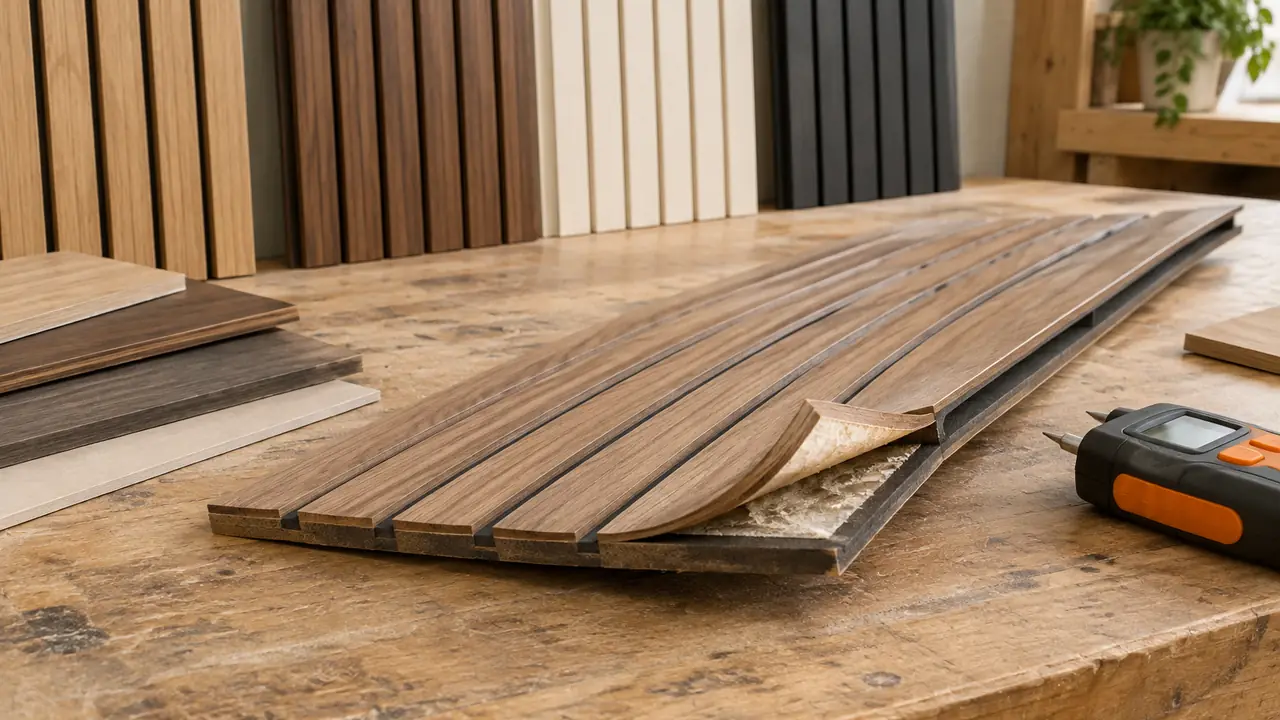
What a panel warranty can honestly be
A useful warranty on decorative panels is not a promise that wood stops behaving like wood. It is a bounded commitment: the panels shipped matched the specification and the agreed inspection results, and if a manufacturing defect surfaces within a stated window, there is a stated remedy. Everything else - installation errors, storage conditions, site accidents, and the material's own honest behaviors such as seasonal movement or the patina of an oiled surface - belongs outside the coverage and inside the documentation, where the care sheet and install sheet explain it before the purchase. That boundary is not evasive; it is the difference between a warranty a plant can stand behind for years and one that quietly becomes a marketing sentence.
For importers the practical structure has four elements. Coverage classes: what counts as a manufacturing defect - bond failures, finish faults, dimensional deviations beyond the agreed tolerance, documents that do not match the lot. Duration and claim window: how long coverage runs and how quickly a claim must be raised with evidence. Evidence: what a claim must carry - photographs, lot references, inspection records, moisture or installation notes as relevant. Remedy: replacement panels from the same lot where available, spares where not, or a negotiated settlement. Each element is writable, checkable and consistent across the series of failures this group has walked through.
The coverage map: what fails, who answers
The map below is the whole problems series compressed into one table, and it is the document to agree before production rather than after the first claim. Its logic is the boundary just drawn: manufacturing defects belong to the plant and the program's quality gates; transit belongs to carriers and the evidence chain; installation, storage and material behavior belong to documentation and the service content around the product.
| Failure category | Typical coverage answer | Evidence that decides it | Program prevention |
|---|---|---|---|
| Manufacturing defect: bond, finish, dimensions | Covered within the window | Inspection records; per-lot certificates; claim photos | Agreed checks per lot before shipment |
| Transit damage | Carrier or insurance, on evidence | Loading photos; receipt inspection; delivery exceptions | Packaging spec; container photo log |
| Installation error | Not covered; guided instead | Install sheet acknowledgment; site notes | Install sheet with survey, gaps, fasteners |
| Storage and site conditions | Not covered; prevented by guidance | Storage page; moisture readings at handover | Storage and opening instructions |
| Normal material behavior: movement, patina | Named, not claimed | The specification itself | Listing and care sheet state the behavior |
Who holds the claim: the desk's role
In a sourced supply chain the claim travels a defined path. The brand collects evidence and raises it; the desk - which coordinated the program and holds the inspection file - takes it to the partner plant that produced the lot; the plant answers against the records both parties agreed on before production. This is why the desk insists on inspection agreements signed before manufacturing: a claim with an agreed inspection file behind it settles in exchanges, while a claim without one settles, if at all, in attrition. Certificates are held by plants per lot and verified per project - the desk verifies rather than owns them - so the paper trail leads where the responsibility leads.
The same file serves the quieter cases. A batch that drifts from the retained swatch, a packaging spec a plant stopped following, a dimensional tolerance creeping at the edge of its limit: none of these is a claim, and all of them are corrections - visible only to programs that inspect per lot and keep the records. The quality machinery on the quality control page is, from the warranty side, claim prevention running continuously.
Spare parts: the warranty that never files a claim
Most panel failures never become warranty cases - they become service events, and the spare-parts plan decides their cost. The plan has three tiers. First, spares shipped with the program: a modest overage of panels per color from the same lot, which match perfectly and cover installer cuts and small transit residuals; the ratio is a program decision taken with the order, not a formula. Second, trims and small parts ordered with the drawing: end caps, corner pieces and banding counted as line items - trims are commonly ordered by the thousand pieces - because a repair finished with a color-matched trim reads as design, while one improvised on site reads as repair. The trim line carries the matching logic.
Third, the repeat-order lane: the arrangement that lets a brand order its walnut again in year three and receive the same tone. This is the retained-swatch system doing its long work - the frozen color standard, checked under a standard lamp, that makes a later lot match an earlier wall - and it is why the desk asks for the color plan before quoting and keeps swatch discipline across the program, as the batch matching note explains. Programs that let a color lapse into rediscovery lose more than tone: they lose the ability to repair their own installed base, which is the quietest way a product line ages out of its market. Where colors are custom, the OEM and private label page records the matching arrangement as part of the program.
What the structure means for returns and for the brand
Warranty and spares are the downstream half of returns reduction. Most returns trace to failures this series has ranked - damage, chips, expectations that outran the spec - and every one is cheaper at the spares stage than at the returns stage: a swap panel costs a fraction of a return's freight and review risk. The upstream half is specification and inspection, and the two halves meet in the same file: the program that inspected per lot knows what it shipped, the program that stated behaviors in its listing knows what it promised, and the space between those two facts is the only territory a warranty has to defend. The returns-side arithmetic is walked in the returns reduction note.
For the brand's market positioning, the structure is also a sales asset in careful wording: a listing that states coverage classes, evidence expectations and the availability of matched spares answers the question sophisticated buyers actually ask - not "will it ever fail" but "what happens when something does". That answer, in writing, closes enterprise deals that adjectives do not.
Specification and inspection: the closing lines
The group's method fits on one line: rank the causes, write the prevention into the specification, verify it in the inspection plan, and keep the records where a claim can reach them. For this note specifically, the program lines are: coverage classes and claim windows agreed in the order; evidence expectations written down before production; spares per color and trims per drawing included in the order; the retained swatch frozen at approval and honored across repeat lots; and the whole file - certificates per lot, inspection records, packaging and loading logs - kept by the desk where both brand and plant can reach it. A panel line run this way treats its rare failures as service events with paper behind them, which is the most a materials program can promise and exactly what a professional one should.
Reference quantities, production windows and repeat-order schedules sit on the MOQ and lead time page, and the quote form starts the file: destination, color plan, certificates and packaging tier in one structured message.