
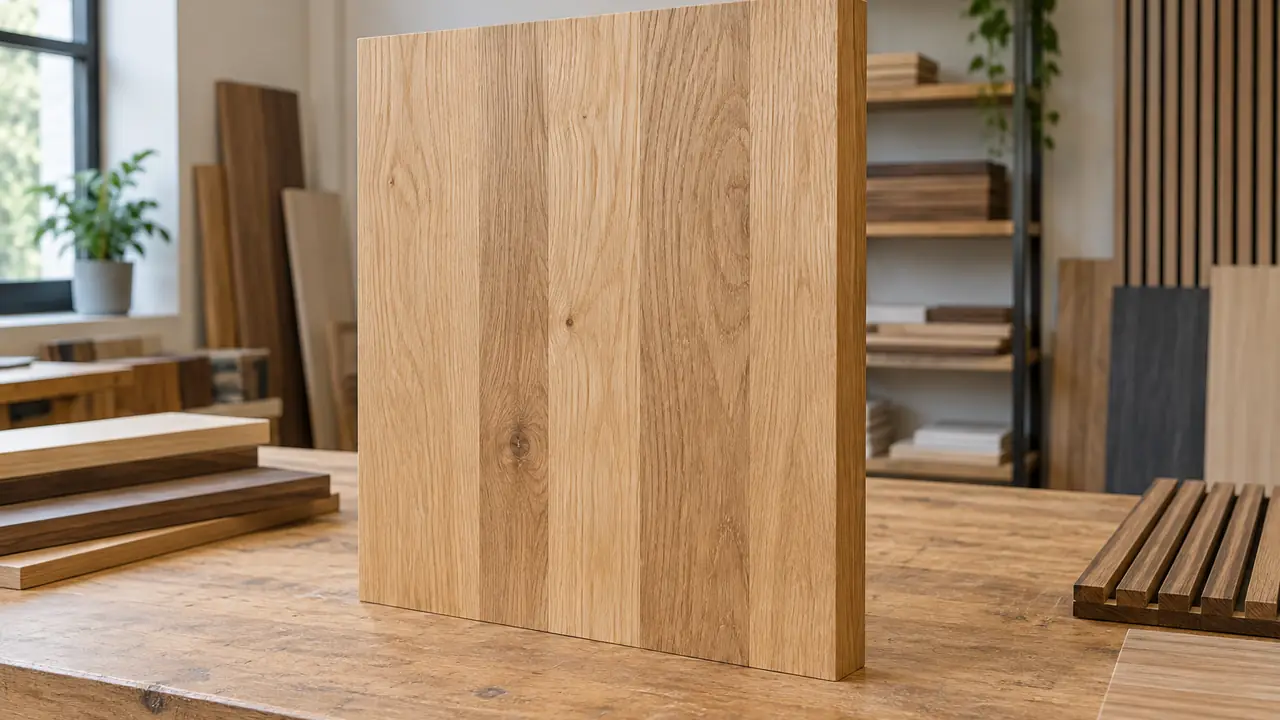
What a solid wood panel is
A solid wood panel is full-thickness timber milled into strips and joined edge to edge - or finger-jointed in shorter sections - into a flat board. Strips stay narrow by design: narrow members balance the natural movement of the wood, so a glued panel stays flatter than a wide single board ever could. Typical builds run 15-40 mm thick with sizes up to 1250 x 2500 mm, in oak, walnut and pine as the trade staples. The face needs no veneer; the species is the finish, sanded and sealed or oiled.
Moisture content is the discipline that defines the line. Panels are typically dried to 8-12% matched to the destination climate - a panel conditioned for a dry interior will move in a humid one, and the reverse. That is why the desk asks for the destination before quoting, and why the moisture and warping note belongs on every solid program reading list.
The six layers on the card
The swatch sketch shows the strip construction; the card lists the parts in the order a plant quotes them.
| Part | What decides quality | Typical options |
|---|---|---|
| 1 Face layer | Species reads here | Oak, walnut or pine strips, planed and sanded; oiled or lacquered |
| 2 Core or body | The panel itself | Edge-glued or finger-jointed strips, 15-40 mm |
| 3 Rear layer | Movement relief | Unfinished rear with relief grooves; sealed on request |
| 4 Edges and trims | Visible edges | Square or chamfered; matching solid lipping on request |
| 5 Fixings and system | Movement-tolerant install | Clips or slotted screws to battens, never rigid glue |
| 6 Packaging | Heavy goods handling | Shrink-wrapped bundles, foam interleaves, crated stacks for projects |
Dimensions and moisture bands are typical across the category and confirmed on each program sheet; kiln records back them per lot.
Species and what they change
Oak carries most ranges: familiar grain, takes stain well, reads premium without shouting. Walnut is the depth tone, priced accordingly and often reserved for hero walls and headboards. Pine is the value tone, lighter and softer, common in budget hospitality lines where profile and paint matter more than figure. Because all three are natural material, color moves batch to batch and is held to a retained swatch under a standard lamp - the same discipline the veneer line runs, with a wider natural spread.
| Species | Reads as | Typical role in a range |
|---|---|---|
| Oak | Warm, straight grain, takes stain | The ladder base and bestseller tone |
| Walnut | Deep brown, variegated figure | Hero walls, headboards, premium tiers |
| Pine | Light, knotty, paint-friendly | Value lines, painted programs |
Joint style is the second lever. Edge-glued strips keep a continuous face grain and suit visible walls; finger-jointed sections use shorter stock, hold price down and usually sit behind paint or stain. Both belong on the same spec sheet, chosen per color rather than per line.
Solid versus veneer, honestly framed
Solid wins on refinishability, edge profile and the weight in the hand that premium segments expect. It covers wall at a higher weight, demands movement gaps, acclimatization and a sturdier substructure, and natural color variation needs managing. Veneer panels cover faster, weigh less and hold color steadily across a ladder. Most ranges use both: solid for feature and tactile zones, veneer for coverage. The side-by-side note and the veneer line page carry the detail.
Where the panels are made
Solid strip capacity sits with the furniture-board makers across Shandong and in the plywood belt of Pizhou and Jiashan, with Guangdong plants cutting premium species for project work. Kiln control and the moisture document separate plants here more than press lines do; the desk reviews drying records before sampling a solid program. More on the clusters.
Inspection before shipment
- Thickness and size on sampled panels against the program sheet.
- Joint gaps and glue lines under raking light; tap test for delamination.
- Moisture content against the destination band, meter-checked per lot.
- Color against the retained swatch; species verification per bundle.
- Finish adhesion and scratch check on sealed faces.
- Bundle build, interleaves and crate drop test against the approved sheet.
The plan is written per program and confirmed before the first batch; see quality control. Reference quantities and timing sit on the MOQ and lead time page, and the quote form asks what a plant will ask.