
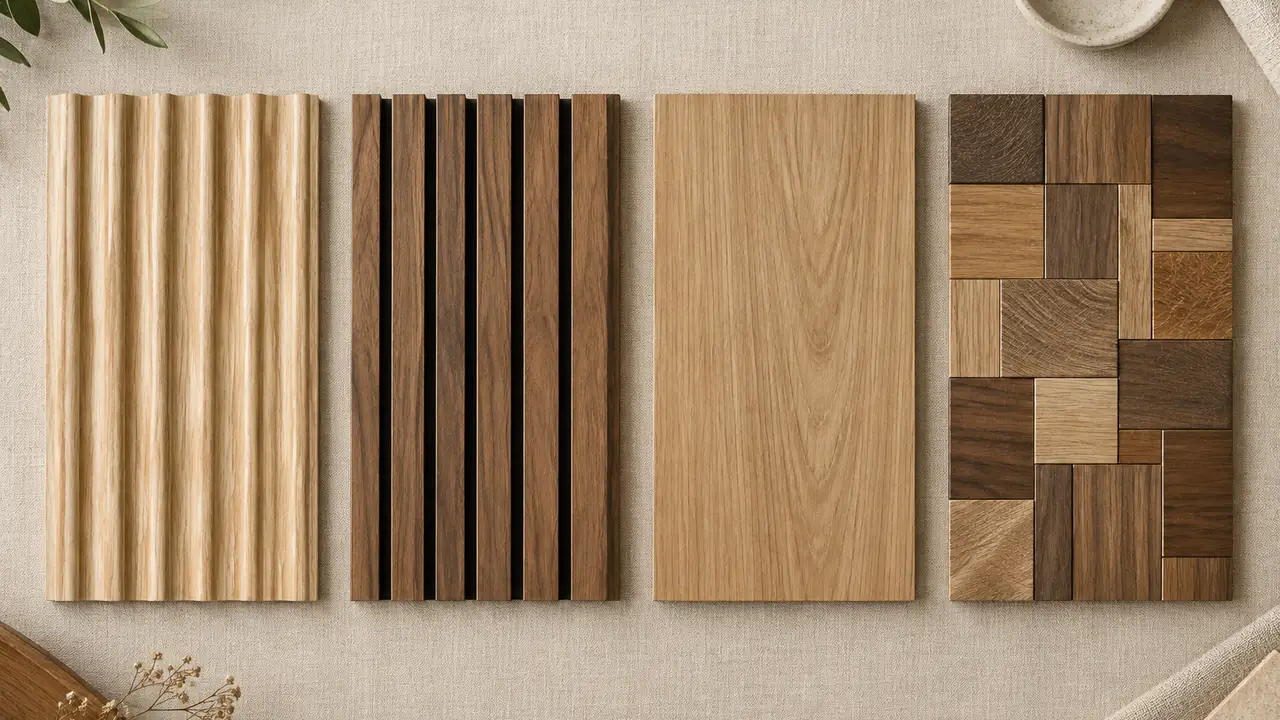
What a solid panel is
A solid wood panel is not a sandwich. Strips of one species - oak, walnut or pine across most export ranges - are joined into a single board, with no core, no face layer and no backing: the material is the panel. Typical category ranges, confirmed per spec sheet: thickness from 15-40 mm, formats up to 1250 x 2500 mm. The construction buys three things no engineered panel fully replicates: an edge that shows honest end grain, a surface that can be sanded and re-oiled years later, and a depth under the hand that reads as furniture rather than cladding. It also takes on a responsibility the sandwich families delegate to their cores - movement - which is why this guide spends more words on moisture than on anything else.
Where the line earns its keep: feature walls at arm's length, reception desks, bar fronts, boutique changing rooms, headboards - anywhere a hand will rest and an edge will show. The veneer versus solid note puts the two constructions side by side for buyers torn between them; the short version is matched grain at scale versus material honesty at touch.
Species: three characters to choose from
Oak is the default of the export range: pronounced but orderly grain, a warm mid tone that stains predictably, and enough hardness for public spaces. Walnut carries the premium tier - deeper tone, flowing figure, a surface that photographs like the brand story it sits behind. Pine is the value tier: light, knotty where left natural, calm where knotted out, and honest about what it is. Within each species the questions are grade and origin discipline - how knots and sap are graded per the plant standard, and what the chain-of-custody documentation looks like per lot, since FSC or PEFC claims travel with the wood lot by lot, never as a blanket statement about a range.
Species also sets the finishing conversation. Oiled surfaces deepen tone and stay repairable on site; lacquered surfaces standardize sheen across batches. The finishes note compares the routes, and the choice should be made before sampling because it changes how the same board reads.
Joints: finger-jointed versus edge-glued
| Joint | How it is made | How it reads on the wall | Where it fits |
|---|---|---|---|
| Finger-jointed | Short staves glued end-to-end into long lamellas, then laminated side by side | Small arrow-like joins visible in the grain | Long, stable, value-led builds; painted or heavily toned finishes |
| Edge-glued | Full-length strips glued face to face along their edges | Continuous strip grain from end to end | Premium surfaces where the grain line is the design |
Neither joint is a quality verdict; they are different economics. Finger-jointing turns short offcuts into long, stable lamellas and wastes little timber, which is why it prices gentler and why it appears under opaque finishes where the joins disappear anyway. Edge-gluing preserves the full-length grain line that premium surfaces are bought for, and it consumes the long clear stock that commands the premium. What a buyer should insist on either way is glue discipline and press records - delamination along lamellas is the failure mode of a badly made solid panel - and a stated moisture class per destination.
Moisture: the conversation that decides the outcome
Solid panels are stable only in partnership with the air around them. Wood takes up and releases moisture with the seasons, so panels are typically dried to roughly 8-12% moisture content, matched to the destination climate before shipment - a desert interior and a coastal one are different orders, and a heated northern interior is a third. Specify the destination when the order is placed; the plant conditions to it, and the panel arrives ready to live there. Skip the step and the movement shows up months later as cupping, open joints or surface checking, a story the warping note tells in detail and the moisture note continues.
Two practical corollaries follow. First, seal all six sides - the back and the edges as carefully as the face - because an unsealed back is an open door for humidity. Second, let the fixing system breathe: slotted fixings and fixings that allow seasonal movement keep the panel honest, while rigid fixing at every point fights the wood and eventually loses.
Quantities, samples and lead time
Solid and other veneered-family lines commonly start around 100-300 sq m per color or species across the category, confirmed in writing per program; the typical ranges sit on the MOQ and lead time page. Panel samples typically take 7-15 working days; bulk production for veneered-family lines runs 25-45 days, with a longer first run where a custom finish or an unusual format is involved. Weight is the freight story of this family: a 40-foot high-cube container carries roughly 800-1,200 sq m depending on thickness and packaging, and a solid program at the thick end of the 15-40 mm band consumes that volume faster than any veneered line. Plan area, thickness and container together, not as separate conversations.
What to ask a partner plant
- Which species and grades the plant runs as standard, and what the knot and sap grading standard actually says.
- Which joint the quotation assumes - finger-jointed or edge-glued - and what the lamella widths are.
- What moisture content the panels are conditioned to, and how it is matched and recorded for the destination climate.
- How lamella bond quality is tested and recorded, since delamination is the failure mode to design out.
- What chain-of-custody documentation travels with the species per lot, where a certified source is part of the brief.
- How edges and backs are sealed, and what the fixing recommendation allows for seasonal movement.
- What the written confirmation covers: area per species, conditioning class, documents, and the repeat-order lane.
How the desk frames a solid program
A solid panel program through this desk starts with three questions: how close will people get, what climate is the destination, and how much of the story is the grain line itself. Arm's-length surfaces and visible edges argue for the species; the climate fixes the conditioning class; the grain-line answer fixes the joint. The desk then shortlists partner plants by species - solid-strip specialists are usually different plants from veneer specialists, which is exactly why a sourcing desk coordinates rather than manufactures - orders samples against the retained swatch, and freezes finish and conditioning in writing before bulk. Management systems such as ISO 9001 are verified per plant. When the three answers are drafted, the quote form puts species, joint, conditioning class and documents in front of the shortlist at once, and the desk returns options with the records each plant holds best.