
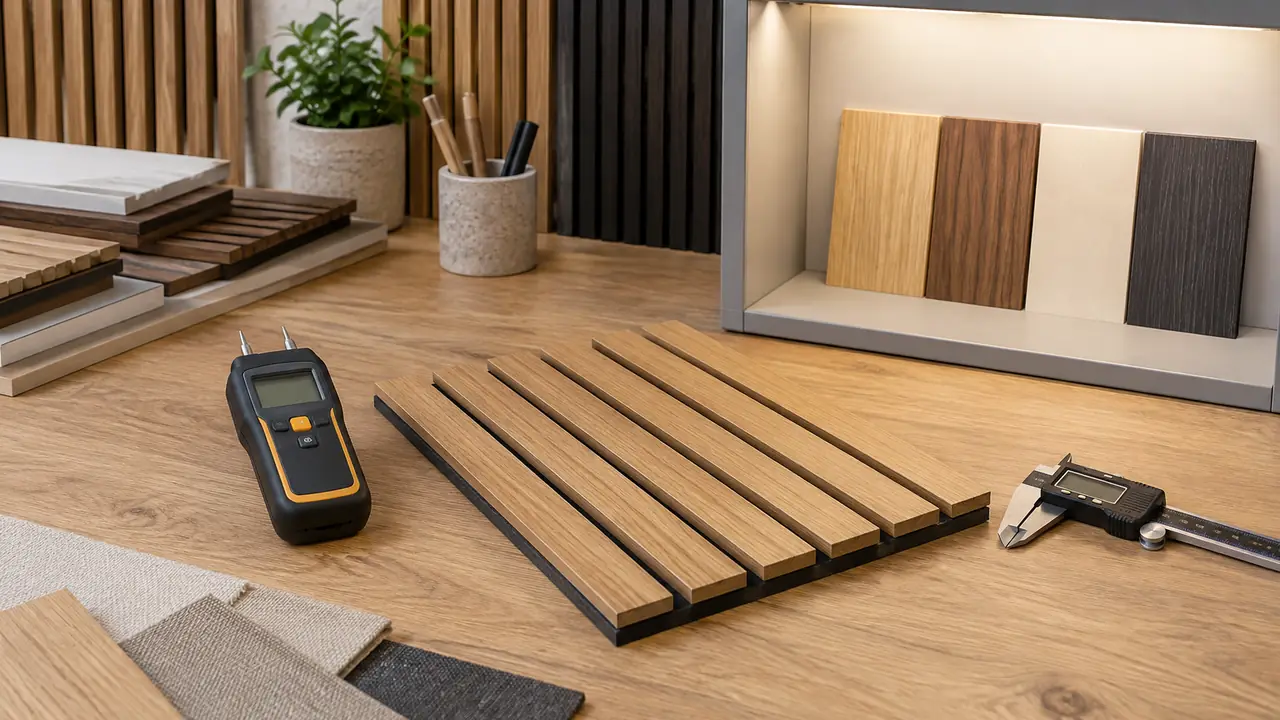
Why panels move
Wood-based materials absorb and release moisture until they settle where the surrounding air pushes them. Absorption swells the material; drying shrinks it. When the two faces of a panel sit at different moisture levels, the panel bends toward the drier side, and the classic shapes appear. Solid strip construction moves with the grain and shows the strongest seasonal response; MDF, being a homogeneous fiber panel, is steadier in the flat but still responds at the edges; plywood balances through its cross-laminated structure; and WPC, a blend of polymer and wood flour, is the least hygroscopic of the lines while still following the rules of its spec sheet. None of the lines is motionless. The differences are in how much, how fast and in which direction.
For a buyer the practical reading is this: warping is not a lottery, it is a chain - the moisture class the plant dried to, the way the panels were wrapped and shipped, the climate they crossed, the room they waited in and the fixing system that holds them. Every link is specifiable, which is why the desk specifies them.
The moisture class and the destination climate
Solid wood panels are commonly specified at a moisture content of 8-12 percent, matched to the destination climate per spec sheet - drier specifications for heated interiors in cold winters, higher for humid coastal regions. The number is not decoration; it is the plant declaring the equilibrium the material was dried toward. A panel dried for one climate and installed into a very different one will spend its first season finding the local balance, and it will move while doing it. Container transit adds its own chapter: sealed cartons cross oceans through humid and dry stretches, and film wrapping is part of the moisture plan, not only scratch protection.
Acclimatization completes the chain. Industry practice lets panels rest, still wrapped, in the room where they will be installed, so the material reaches the room condition before it is fixed - the installation detail states how long and in what condition. The solid wood panel line carries the moisture class as a named specification for exactly this reason.
How movement actually shows up
Each failure shape has its own biography, and naming the shape is halfway to naming the cause. The patterns below cover most of what reaches a claims conversation, and the desk keeps them in mind when writing the inspection plan rather than when arguing about the wall.
| Pattern | What it looks like | Typical driver | What prevents it |
|---|---|---|---|
| Bow | A long curve along the panel length | Moisture imbalance between the faces, poor stack storage | Balanced construction, flat storage, correct moisture class |
| Cup | Edges lift across the panel width | One face wetter than the other over time | Sealed or balanced rear face, acclimatization before fixing |
| Twist | Corners leave the plane | Storage stress and mixed grain response | Flat stacking, edge protection, moisture control per lot |
| Gapping | Joints open after installation | Shrinkage in a dry heating season | Moisture class for the destination, expansion gaps per the install detail |
| Telegraphing | Core or battens read through the veneer | Core movement or uneven pressing | Quality core, sound adhesive line, agreed flatness tolerance |
Storage, transit and site practice
Most movement damage is written before installation day. In the warehouse, panels belong flat, on bearers, away from exterior doors and direct heat, wrapped until the hour they are fixed. In transit, the wrapper and the carton carry the moisture plan across the ocean, and torn film discovered at receiving is worth a photograph and a note, because it is cheaper to settle then than after the panels have spent a winter adjusting. On site, the rules are short and old: flat off the floor, away from fresh plaster and open windows, wrapped until acclimatized. The installation systems guide carries the fixing-side detail, including the expansion gaps that give a finished wall somewhere to move, and the warping causes note traces the failure paths one by one for installers.
Wet areas deserve their own sentence. WPC lines are specified as water-resistant per spec for wet and outdoor exposure, and the desk keeps the wording there - water-resistant per spec, not waterproof - because the difference matters in both the claim and the expectation.
The checks that keep walls flat
Moisture is one of the checklist items the desk agrees before production, not one discovered at the claim. Pre-shipment inspection includes moisture content readings per lot, flatness measured against the agreed tolerance, and packaging checks - wrap integrity, corner protection, drop behavior - because packaging is the first line of the moisture plan. Where a project needs documented readings, the moisture figures are recorded per lot and filed with the order documents, so a year later the program can show what left the plant and in what condition. The quality control page describes the checklist and how it attaches to an order, and storage culture inside the plant is part of the factory audit conversation rather than an assumption.
Climate is the other half of prevention. A program selling into heated northern interiors and one selling into humid coastal markets are not the same specification, and the desk writes the moisture class accordingly - the same color card can carry two moisture targets if the destinations differ. Humid storage after arrival has its own failure mode, which the mold and storage note covers for warehouse teams.
Writing moisture into the order
Three lines in the order file close the moisture question: the moisture class matched to the destination, per spec sheet; the packaging and storage guidance that travels with the panels; and the installation detail with acclimatization and expansion gaps stated, so the fixing crew inherits the plan instead of inventing one. Reference quantities and schedules stay as ranges confirmed in writing per order - veneered wall panels commonly from around 100-300 square metres per color, production in the 25-45 day band for veneer families - as set out on the MOQ and lead time page. To have the desk match a moisture class and inspection plan to a destination, the quote form collects the market and the install conditions in one submission.