
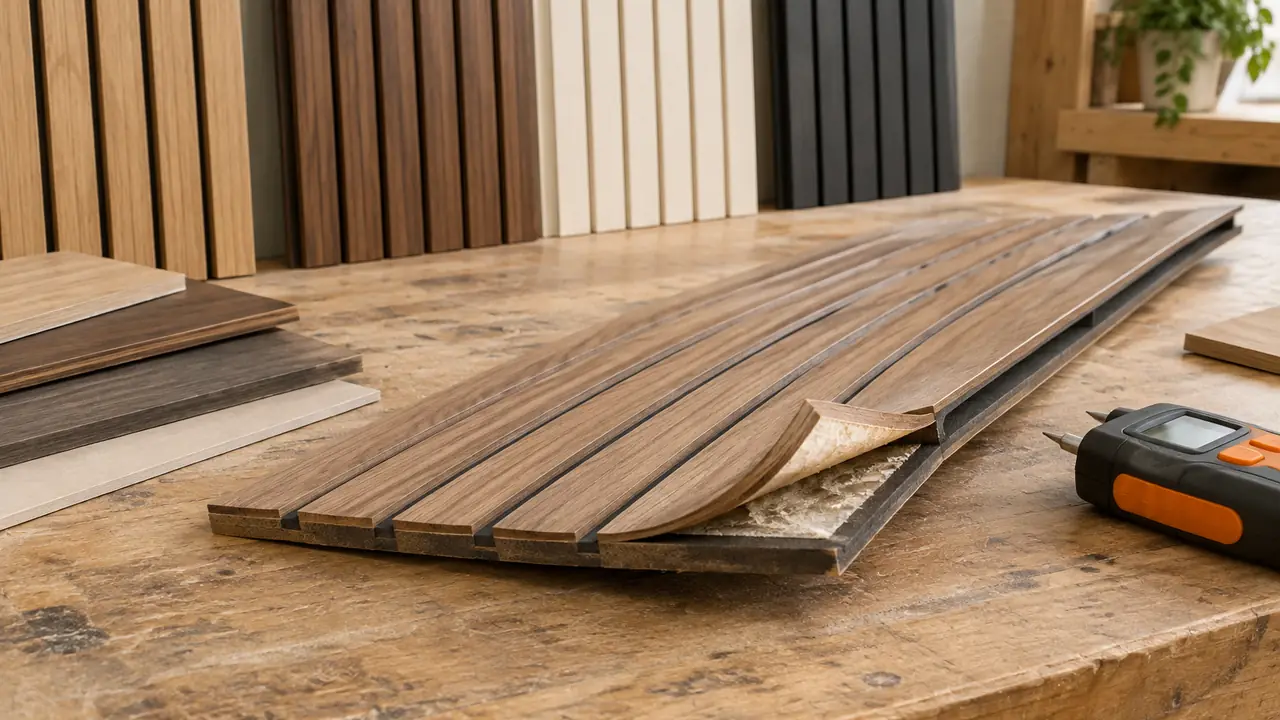
A storage and logistics question, stated plainly
This note treats surface growth on panels as what it is for a sourcing program: a material and logistics problem with an evidence trail. Wood is hygroscopic - it exchanges moisture with the air - and a wood surface that sits at elevated moisture for long enough can support surface growth the way any organic surface can. That is a property of the material, not a verdict on any plant, and the productive conversation is about where the moisture came from: a container, a warehouse, a wrapped pallet or a wet site. Programs that frame it this way prevent it; programs that frame it as a blame question meet it repeatedly.
Two boundary notes keep the discussion honest. First, this is a quality and claims matter, and this desk treats it as one - the material questions are whether the panel's structure and finish survived the exposure, and what the certificate and inspection trail show. Second, prevention is shared: the plant conditions the panel, the packer designs the packaging, the forwarder moves the container, and the receiver stores it. Each party controls one exposure point, and the ranking below follows the panel's journey.
First exposure: the container crossing
The most frequent origin is the ocean container. A sealed steel box crosses climate zones in weeks - a producing region's humid summer air is packed inside with the goods, the box cools at night and on the water, and moisture condenses on the roof and walls in the pattern logistics calls container rain. Water then drips and runs onto the top cartons, and a program's first sign of trouble is staining in a neat line along the upper layer of a stack. Sea transit runs 15-25 days to North America's west coast and 30-45 days to Europe per the category's typical ranges, and any of it is long enough for a wet container to leave marks.
The countermeasures are packaging decisions, agreed in the program rather than improvised at loading: moisture-managing wrap specified rather than default film, desiccant load calculated per container for the route and season, and carton design that sheds drips away from panel faces. The packaging page and the logistics page both carry the coordination points, and a moisture reading at loading - panels documented dry before the doors close - is the evidence anchor that later separates transit damage from storage damage.
Second and third: warehouses at both ends
Second is the warehouse, at origin or destination. Panels stacked on cold concrete wick and condense at the bottom layer; bales leaned against uninsulated exterior walls sit in the dew-point zone; unconditioned sheds in humid coastal climates hold air that keeps wood surface moisture elevated for months. None of these look like neglect from inside the building - they look like storage, and the damage accumulates below the surface of the wrap where nobody checks. The countermeasures are a storage page in the program file: pallets off the floor on bearers, a gap from exterior walls, wrap opened or ventilation provided for long storage, and first-in-first-out discipline so no lot winters over twice.
Third is panels packed wetter than their destination. Wood reaches equilibrium with the air around it - solid material is typically dried to roughly 8-12% moisture content matched to the destination climate per spec sheet - and a panel conditioned for a dry interior market and shipped to a tropical one will sit above its new equilibrium for a season, its surface running damper than it ever ran in the plant. Conditioning to destination, and stating the destination in the order, is the same lever the warp discussion turns on, and the moisture reading per lot at inspection documents it.
The exposure points side by side
| Stage | Moisture driver | Countermeasure | Check that documents it |
|---|---|---|---|
| Container transit | Condensation on steel; drips onto top layers | Specified wrap, calculated desiccants, drip-shedding cartons | Moisture reading at loading; container photo log |
| Port and transit storage | Humid sheds; long dwell times | Route planning; minimized dwell | Forwarder milestones in the program file |
| Destination warehouse | Cold floors, exterior walls, still air | Bearers, wall gaps, ventilation, FIFO | Storage page acknowledged by the receiver |
| Packaging itself | Sealed wrap trapping moisture for months | Ventilation strategy for long storage per program | Opening protocol in the care sheet |
| Site storage | Wrapped bales outdoors, ground contact | Dry covered storage named in the install sheet | Installer acknowledgment |
What the risk means for a brand
For an importer, an affected shipment is a commercial event with a paper solution. The sequence that works: document on arrival - photographs before unwrapping, moisture readings on affected and unaffected panels, carton and container condition noted; then triage by inspection - surface staining on sealed faces with intact finish and bond can often be cleaned and retained, while growth that has marked porous or unfinished surfaces, or that coincides with swelling, usually means replacement; then claim where the evidence points - marine insurance and carrier claims both run on documentation windows, and a loading-time moisture reading plus an arrival-time reading is the difference between a recoverable claim and a write-off. The shipping damage note lays out the evidence protocol that claims adjusters expect.
There is also a range-planning angle. Programs serving consistently humid coastal or tropical markets can weigh material choices at the line level - interior WPC profiles, for instance, are polymer-rich boards that do not feed surface growth the way wood faces do, water-resistant per spec sheet, covered on the WPC line page - and set storage expectations in trade documentation rather than learning them by claim. Neither route removes the storage obligation; both reduce how expensive a missed one is.
Specification and inspection: the moisture ledger
The program lines that close this file. Specification: destination climate stated in the order, conditioning range named per spec sheet, packaging spec covering wrap strategy and desiccant load per container, and a storage-and-opening page in the program file for the receiver. Inspection: moisture reading per lot at the plant and documented, packaging verified at loading with a container photo log, moisture re-read at receipt, and the claim window written into the logistics plan. With that ledger, surface growth becomes a rare, attributable and recoverable event instead of a recurring argument - and every party's part of the prevention is on paper where it belongs.
The desk builds the ledger into programs as routine: reference quantities and schedules sit on the MOQ and lead time page, and the quote form captures destination climate and packaging tier alongside color and area, which is where this prevention starts.