
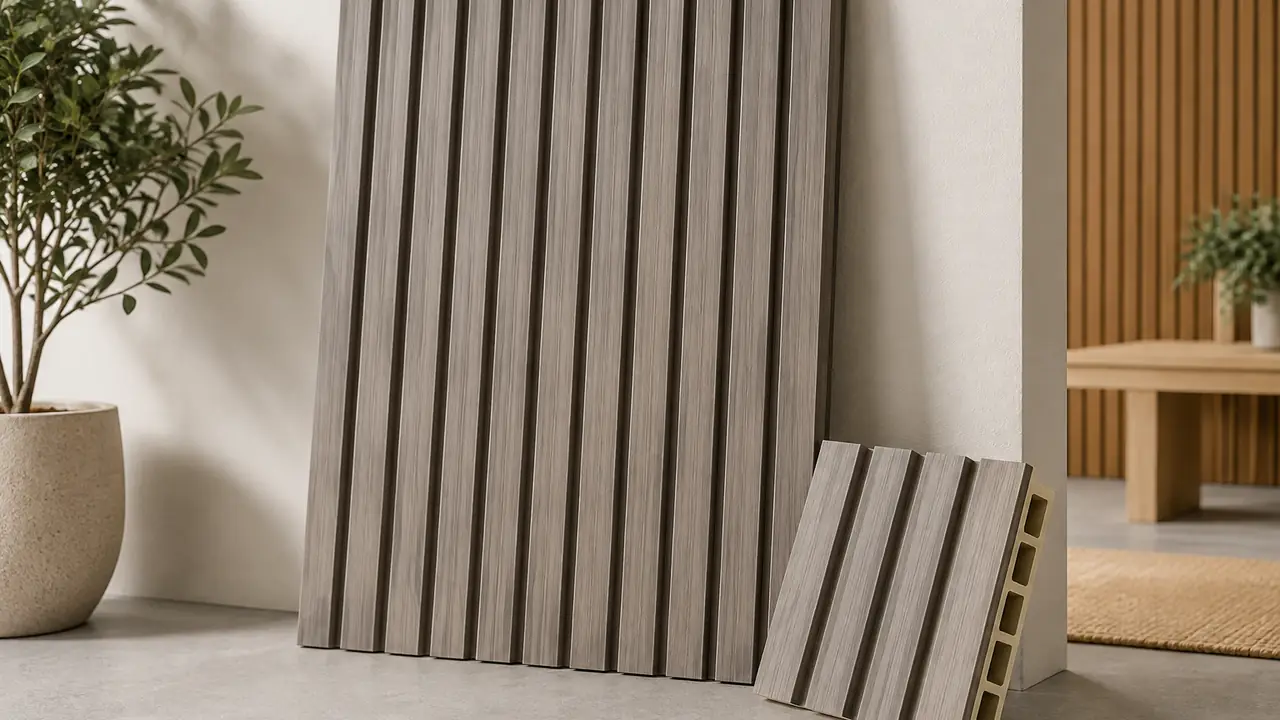
What a WPC wall panel is
WPC - wood-plastic composite - is extruded, not pressed: a compound of PE or PVC and wood flour, typically at least half wood content by weight, pushed through a profile die. Indoor lines come as slat and fluted profiles 9-21 mm thick that borrow the slat family rhythm without its felt; outdoor lines are co-extruded boards with a polymer skin bonded over the core. One material system, two very different duty cycles.
For buyers the appeal is environment tolerance: profiles are water-resistant per spec sheet, so bathrooms, kitchens, covered terraces and poolside walls that would swell an MDF board are routine work for this line. The red line stays red: water-resistant per spec is the honest claim, never waterproof, because joints, cut ends and fixings remain design decisions. Demand splits the same way, with outdoor slat cladding queries growing alongside indoor slat walls in the Semrush set behind this site.
The six layers on the card
The swatch sketch shows the profile; the card lists the parts in the order a plant quotes them.
| Part | What decides quality | Typical options |
|---|---|---|
| 1 Face layer | The look and the armor | Co-extruded UV skin outdoors; embossed wood-grain finish indoors |
| 2 Core or body | The profile itself | PE or PVC compound with 50%+ wood flour, 9-21 mm |
| 3 Rear layer | Water management | Hollow cells or solid rear with drainage channels outdoors |
| 4 Edges and trims | Closing the field | Matching trims, corner profiles and start clips in the same color |
| 5 Fixings and system | Hidden fixings | Color-matched clips and screws to joists or battens |
| 6 Packaging | Long-profile protection | Woven wrap and corner boards; carton-per-piece for retail boxes |
Dimensions and mixes are typical across the category; each program ships with its own spec sheet, and wet-area wording follows it exactly.
Indoor slats versus outdoor co-extrusion
Indoor WPC slats copy the fluted format at low weight with a wipe-clean face; they hang on battens or rails like any slat wall and suit bathrooms, kitchens and commercial washrooms. Outdoor boards are the more engineered product: the co-extruded skin is the UV and stain barrier protecting the core beneath it, which is why skin formulation is the first question on any outdoor program. UV-stable skins hold color far better than painted surfaces, though no outdoor face stays color-exact forever - expectations should be set from weathering documents, not renders. The UV note and the exterior cladding note set the frame; the outdoor comparison weighs WPC against timber.
Water-resistant, stated carefully
The spec sheet gives the honest wording: profiles are water-resistant per spec, meaning the material does not swell the way unprotected wood composite does in wet service. It is not a waterproofing membrane; substrate preparation, joint design, cut-end sealing and flashing remain the installer craft. Programs for wet rooms and exterior walls should specify profile, fixing and trim as one system so the water path is designed rather than improvised - the installation guide covers the system view.
Options worth specifying
- Duty split. Label every SKU indoor or outdoor; the profiles share a look but not a skin, and the label keeps listings honest.
- Profile rhythm. Slat widths and gaps are set by the die; ask for the die drawing so listing dimensions match shipped goods.
- UV skin grade. On outdoor boards, request the weathering file behind the co-extrusion and set buyer expectations from it.
- Trim kit. Start clips, corner profiles and end caps in the same color; a wall without its trims reads unfinished on camera.
- Retail packaging. Carton-per-piece with barcode and profile drawing suits marketplace channels; see packaging and the marketplace playbook.
Where the panels are made
WPC wall panel capacity is densest in the Linyi belt in Shandong, alongside the bamboo-fiber and PVC profile plants that share its extrusion supply chain, with Guangdong extruders serving premium outdoor programs. Die inventory and co-extrusion capability separate plants more than catalogue length does; the desk checks both plus the certificate file before sampling. More on the clusters.
Inspection before shipment
- Profile dimensions, wall thickness and weight per meter against the die drawing.
- Outdoor boards: skin bond and surface finish; indoor: embossing depth and gloss.
- Color against the retained swatch, indoor and outdoor shades kept separate.
- Clip and trim fit-up on sampled assemblies.
- Water-resistance and weathering documents matched to the program spec.
- Carton-per-piece build, labels and drop test against the approved sheet.
The plan is written per program and confirmed before the first batch; see quality control. Reference quantities and timing sit on the MOQ and lead time page, and the quote form asks what a plant will ask.