
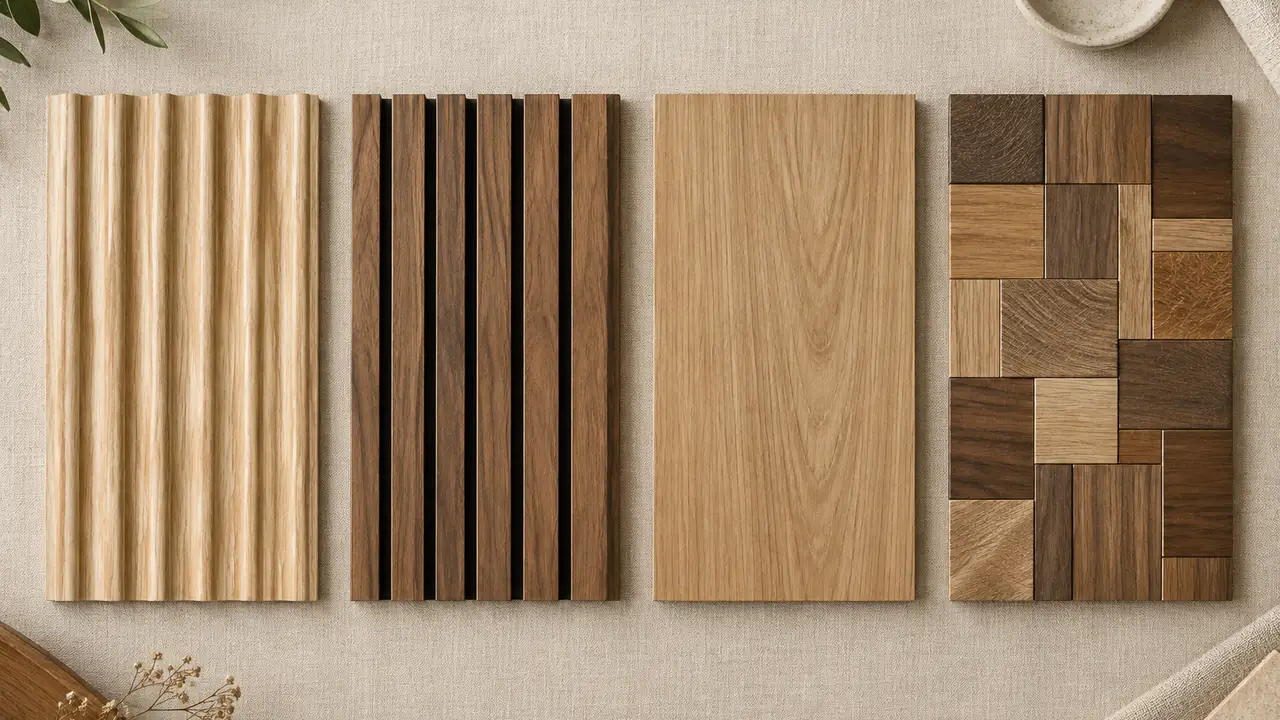
What WPC actually is
WPC - wood-plastic composite - is an extruded product, not a pressed one. Polymer, PE or PVC depending on the build, is blended with wood flour, commonly at half or more of the mix by weight, plus additives, and pushed through a die into profiles. Typical category ranges, confirmed per spec sheet: overall thickness of 9-21 mm, in indoor slat profiles for walls and outdoor boards for weather-facing surfaces. Because the material is homogeneous and the polymer carries it, WPC does not drink water the way wood does and does not telegraph an uneven batten the way a thin MDF panel can. What it gives up is the material story: there is no sliced grain, so color and texture live in the skin, and the skin is where quality is decided.
The buyer for this line has water, sun or both in the brief: wet rooms and humid climates indoors, balconies and exterior feature walls outdoors. The WPC versus solid wood note compares the two materials for outdoor walls; the short version is dimensional calm versus material honesty, and most exterior programs take the calm.
Indoor slats versus outdoor co-extrusion
The two builds share a name and little else. Indoor WPC slat profiles are decorative wall products: vertical rhythm in a material that shrugs off kitchen steam and coastal humidity, fixed on battens or rails like any profile panel. Outdoor boards are protective products: a core wrapped in a co-extruded polymer skin that carries the UV resistance and the weather barrier, because the core alone would fade and chalk within seasons. The co-extrusion line is the expensive half of an outdoor plant, and its quality - bonding, uniformity, thickness of the skin - is the difference between a board that grays gracefully and one that peels. The UV stability note explains what sunlight does to surfaces over years.
A buyer specifying outdoors should treat the skin as the product. Ask how the skin is applied, what its documented performance is, and how the plant demonstrates adhesion between skin and core - the questions that sort outdoor plants from indoor plants with a weather catalogue.
The water-resistant wording
The honest vocabulary matters more in this family than any other, because listings overreach. The defensible claim is water-resistant per spec: WPC absorbs little water, tolerates wet rooms and covered exterior exposure, and stays dimensionally calm where an MDF panel would swell. The indefensible claims are waterproof as an absolute - this desk does not write it - and any phrasing that promises performance without a spec sheet behind it. Joints, cuts and fixings are the pathways water actually takes on any wall, so the installation detail matters as much as the material. The installation systems guide compares fixing routes, and for exterior work the drainage and ventilation gap behind the boards is part of the product, not an installer preference.
| Build | Typical range per spec sheet | Where it goes | The question to ask |
|---|---|---|---|
| Indoor slat profile | 9-21 mm; slat formats on battens or rails | Wet rooms, kitchens, humid climates, feature walls | Which core recipe, and what the surface film claims |
| Outdoor co-extruded board | 9-21 mm; UV skin over the core | Balconies, exterior feature walls, soffits and eaves | How the skin is applied, and how adhesion is proven |
Documents and claim discipline
Three claims surround WPC listings, and each has a documented version. Fire: where a market or project asks, request a class per test report - ASTM E84 or EN 13501-1 for the tested build-up - because polymer-containing products earn their fire documents the same way any panel does, and a listing without a report should not imply one. Weathering: UV and aging performance belongs to the spec sheet and the skin recipe, demonstrated by the plant rather than asserted by the listing. Composition: the wood-flour and polymer share is a plant declaration, and recycled content claims are worth only what the supporting documents are worth. None of these papers belong to a sourcing desk; they belong to partner plants and lots, verified per project - the same discipline as every other family, and the compliance page shows how the document package is assembled.
Quantities, samples and lead time
WPC lines commonly start around 300-500 sq m per color, or by the piece for profile programs, across the category - higher than veneered families because extrusion runs economically in length - confirmed in writing per program; the typical ranges sit on the MOQ and lead time page. Samples typically take 7-15 working days; bulk production commonly runs in the same 25-45-day window as other lines, longer for first custom colors. Logistics favors this family: profiles are light for their coverage, and a 40-foot high-cube container carries roughly 800-1,200 sq m depending on thickness and packaging, so freight per square meter is usually the gentlest in the wall-panel category. For marketplace and e-commerce programs, the per-piece formats and calm dimensions make this the line least likely to come back as a damage claim - the marketplace sellers page collects the listing-side considerations.
What to ask a partner plant
- Which recipes the plant extrudes as standard - PE or PVC base, wood-flour share - and which are proven in production, not just in a catalogue.
- Whether the outdoor line is co-extruded in-house, and how skin-to-core adhesion is tested and recorded.
- What the UV and aging documentation for the skin actually describes, and on what evidence.
- Which fire documents exist for the build being quoted, per test report, if the market or the project needs them.
- What the fixings and ventilation details are for exterior boards, and whether the plant supplies the matching trim system.
- How color consistency is held across extrusion runs, and what the retained standard for each color looks like.
- What the written confirmation covers: area or pieces per color, lead time, documents, and the repeat-order lane.
How the desk frames a WPC program
A WPC program through this desk begins by splitting the brief: indoors or outdoors, wet or weathered, decorative or protective. The answer decides which build, which plant - extrusion specialists for outdoor co-extrusion are a different supplier base from wrapping and pressing plants - and which documents matter. The desk orders samples against the retained standard, checks the skin story on any outdoor build, and freezes recipe, color and documents in writing before bulk. For a brand extending a range into wet zones from a veneered core line, the honest framing on the listing is water-resistant per spec and a documented fire class where claimed. When the split is drafted, the quote form puts build, area and documents in front of the shortlisted plants at once, and the desk returns options with the extrusion and skin records each plant holds best.