
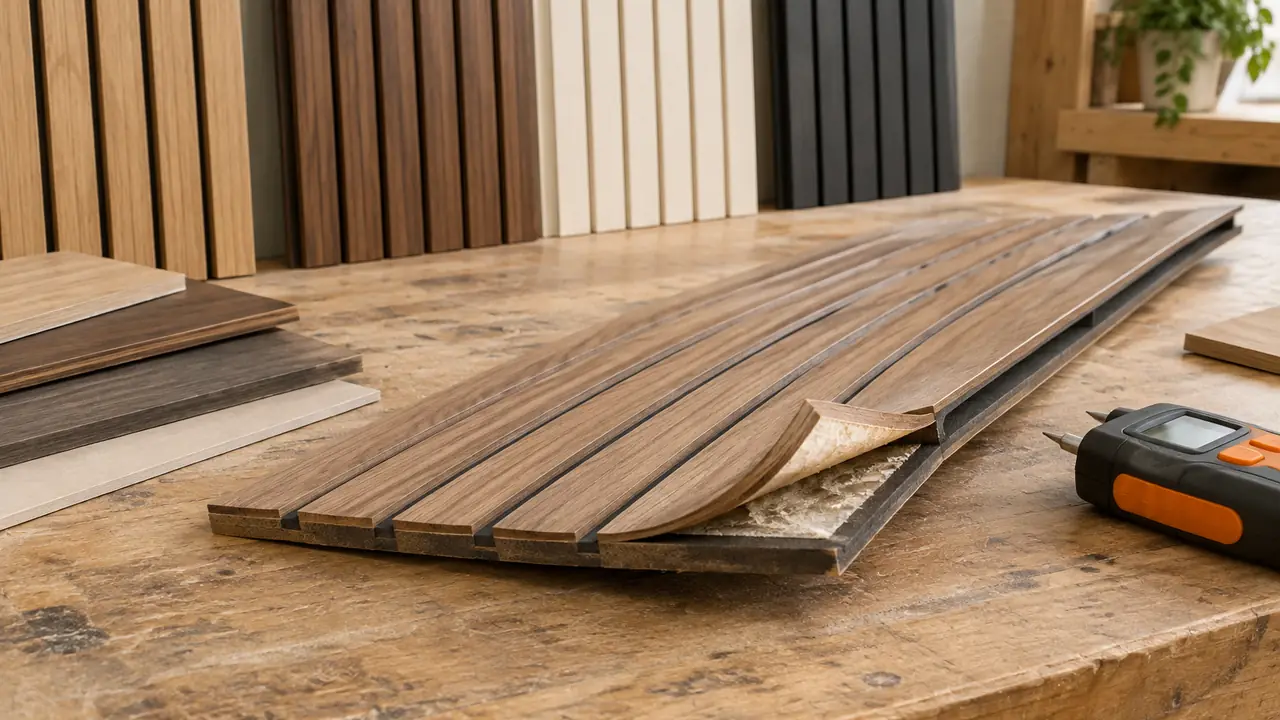
Warp is a physics story before it is a defect story
Wood-based materials exchange moisture with the air around them, and every time one layer of a panel sandwich takes up or releases water faster than another, the panel bends toward the drier side or away from the wetter one. A decorative panel is an engineered stack of materials with different moisture appetites - a veneer face, an MDF or plywood core, a PET felt or backer behind - so it carries the machinery of its own movement unless the program manages it. That is the honest framing a buyer should carry into any warp discussion: most of the time nobody made a bad panel, and almost all of the time somebody skipped a decision that would have kept it flat.
The useful consequence of that framing is that warp prevention divides cleanly into decisions made before production and habits kept after arrival, and the first group matters more. A program that states its destination climate, keeps its sandwich balanced and stores its panels flat has removed three of the four recurring causes before a single carton is packed. The sections below walk the causes in order of how often this desk sees them behind a complaint, then translate them into checks a program can agree on in advance.
First cause: a moisture content mismatch
The most common driver is a gap between the moisture the panel was conditioned to and the moisture of the air it ends up serving. Engineered cores leave a plant balanced to the producing region; solid material is typically dried to roughly 8-12% moisture content, matched to the destination climate per spec sheet. When the destination is assumed rather than stated, a panel can land in air notably drier or more humid than its core expects, and it moves - cupping across the width in dry, heated interiors, or swelling along the edges in coastal humidity. Desert interiors with aggressive air conditioning and humid seaside markets are the classic pairs, and both are entirely foreseeable at the moment an order is written.
The fix costs words, not money: the destination city or climate goes into the order, the plant conditions and documents the moisture class per lot, and the inspection plan includes a moisture reading. Programs that treat this as a shipping detail discover the cost in a warehouse six weeks later; programs that treat it as a specification line rarely discuss warp at all.
Second cause: an unbalanced sandwich
A face layer bonded to one side of a panel pulls as its adhesive sets and as humidity changes through the seasons. If the reverse side has nothing pulling back, the panel cups toward the face - slowly indoors, faster where one side sees sun or a heater. A balancing backer veneer on a flat panel, or the PET felt behind a slat panel, is not decoration; it is the counterweight that keeps the pull even. This is why the desk pushes back when a program deletes the backing to save thickness or cost, and why the panel anatomy note treats the backing as a structural layer rather than an accessory.
The same logic applies to cuts. A panel cut in half on site now has two raw edges and one unbalanced half; sealing cut edges, or planning sizes so most cuts stay on the backed half, keeps the physics quiet. Installers cannot be expected to reason about adhesive chemistry and humidity gradients - the install sheet should simply state which edges get sealed.
Third and fourth: storage and the wall behind
Third in frequency is storage discipline. Panels stored leaning against a wall at an angle develop a set along their length; stacks resting on uneven bearers or on edge points take the same memory. Flat storage on level bearers, weight spread across the face, is the whole rule, and it costs nothing but floor planning - at the plant, at the distribution center and on site. A surprising share of "warped on arrival" photographs show panels that spent three weeks leaning in a corner before the installer opened them.
Fourth is the fixing route. A thin panel fastened tight over an uneven substrate is asked to bridge hollows it cannot bridge; over time panel and fixings negotiate, and the visible result reads as warp even though the panel left the plant flat. Battens packed out to a true plane, or rails adjusted to the wall's survey, remove the negotiation. Adhesive-only installs over hollow drywall are the recurring offender, because glue locks in whatever the wall was. The installation systems guide compares the routes against substrate condition. Fifth, and least common: one-sided heat or sun - a panel above a radiator or behind strong south-facing glass dries faster on one face. The answer there is placement and detailing, not a different panel.
The causes side by side
| Cause | Typical trigger | Prevention before shipment | Prevention after arrival |
|---|---|---|---|
| Moisture mismatch | Destination climate never stated in the order | Conditioning to the destination range per spec sheet; moisture readings per lot | Let packed panels rest in the room before install |
| Unbalanced build | Face veneer with no balancing backer | Backer veneer or felt named on the drawing | Seal cut edges; keep backing intact on refits |
| Storage set | Weeks leaned at an angle on edge points | Flat pallets, level bearers, crate order that stacks flat | Flat storage on site; nothing leaned in corners |
| Fixing strain | Thin panel bridging hollows in the wall | Fixing route agreed against a substrate survey | Pack out battens; set rails to a true plane |
| One-sided heat | Radiator, south glass, cold exterior wall | Placement guidance on the install sheet | Details that break contact with the heat source |
What warp risk means for a brand
For a brand or importer, warp is a returns story, an installer-confidence story and, quietly, a design story. The design levers are real: core selection, thickness and backing balance all move warp resistance, and they cost far less to decide at the drawing stage than to argue about in a claim. Solid lines carry the widest exposure because solid material moves with the seasons by nature - the solid panel line treats conditioning to destination as part of the product. Profile and veneer lines on engineered cores are calmer, provided the sandwich stays balanced and the destination is stated.
There is also a packaging dimension. Panels leave most plants flat and stay flat only if the crate keeps them flat: pallets that carry weight on the face, corner protection that does not dent an edge into a hinge point, and a crate order that stacks heavy cases away from thin panels. Packing choices belong in the order discussion, not in the loading bay - the packaging page shows what the desk coordinates per program.
The checks that catch warp before it ships
Warp prevention survives contact with production only if the inspection plan names it. The checks that earn their keep are unglamorous: a moisture reading per lot against the agreed range, a flatness check on a level table with the panel face up, a look at conditioning records when solid material is involved, and packaging checks that confirm bearers and protection match what the order said. None of these require laboratory equipment; they require an agreement made before production and a person with a checklist - the shape of a standard pre-shipment visit, which the pre-shipment inspection note walks through and the testing and inspection page organizes into an orderable plan.
Batch-level quality systems back this up: plants working to ISO 9001 record conditioning and moisture as routine production data, and the desk verifies those records per lot rather than assuming them. Where a program is sensitive - a large hospitality rollout, a coastal market - the desk adds a mid-production flatness look, because a warp trend caught at half production is a correction, while one caught at final inspection is a claim.
Specification and inspection: the two levers that close the file
Every point above compresses into two sentences a buyer can put in an order. First, the specification: destination climate and moisture class stated, balancing backing named on flat builds, storage guidance printed on the install sheet, fixing route chosen against the wall survey. Second, the inspection: moisture and flatness checks per lot against the agreed numbers, packaging verified against the crate plan, documents filed with the lot. A program that writes both sentences rarely meets warp again except as an installer's storage mistake, which is a different and much cheaper conversation.
The desk turns those sentences into plant instructions and inspection checklists as a routine part of quoting: reference quantities sit on the MOQ and lead time page, and the quote form collects destination, climate and substrate in the same message as color and area - which is exactly where warp prevention starts.