
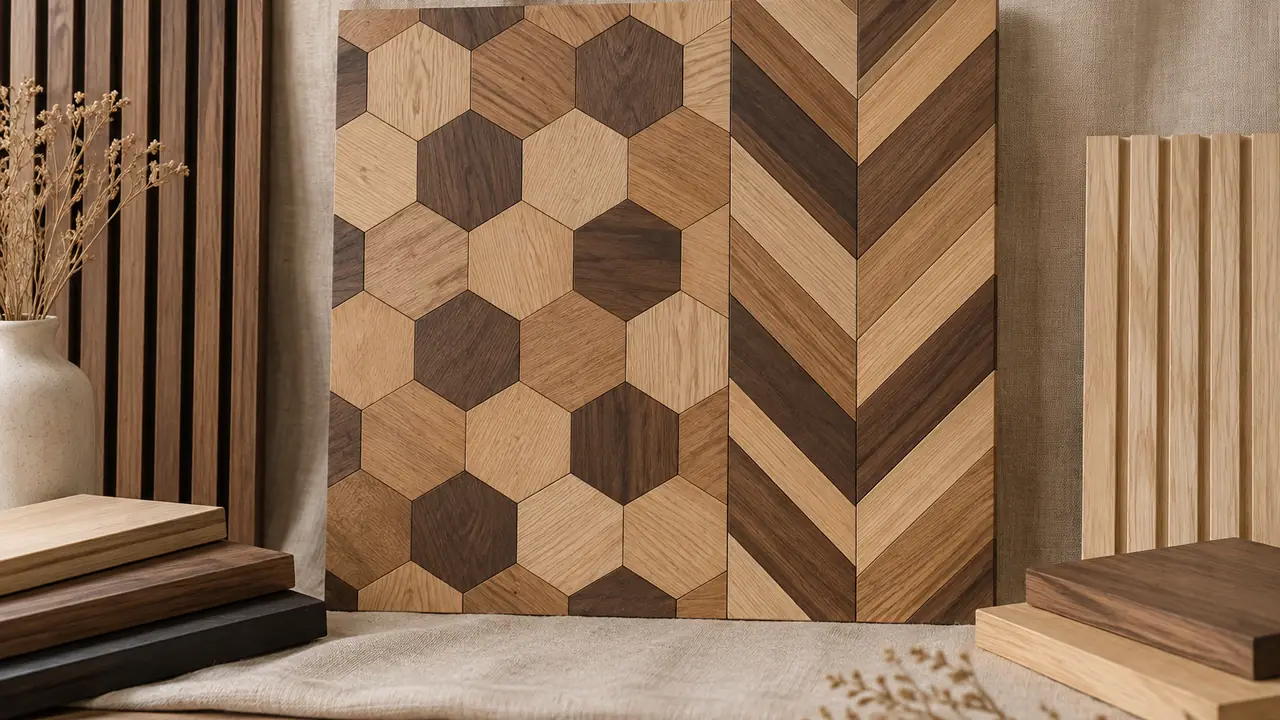
What a mosaic wood panel is
A mosaic wood panel composes small wood pieces - solid blocks or veneer-faced tiles - into a pattern that ships as a finished module. Hexagon, chevron and cubic are the trade workhorses; module sizes run from 300 x 300 mm up to 1200 x 600 mm, and the carrier is MDF or plywood with a balancing backer to keep the composition flat. Where the slat lines sell rhythm, mosaic sells geometry: a feature wall reads as one designed surface instead of hundreds of loose tiles, and the installer mounts modules rather than pieces.
The line also has a supply story worth telling buyers: compositions use offcut-scale material, so premium-species looks reach price points solid board cannot, and the desk can often match a mosaic program to the same species as a veneer or solid line for a coordinated range. It is the lightest way to add real-wood pattern to a boxed program, because modules pack flat and small.
The six layers on the card
The swatch sketch shows the mosaic layout and legend; the card lists the parts in the order a plant quotes them.
| Part | What decides quality | Typical options |
|---|---|---|
| 1 Face layer | The pattern reads here | Solid blocks or veneer-faced pieces, hexagon, chevron or cubic |
| 2 Core or body | The carrier | MDF or plywood carrier holding the composition |
| 3 Rear layer | Flatness in service | Melamine or balancing backer per module |
| 4 Edges and trims | Closing the modules | Perimeter border pieces; matching edge banding per module |
| 5 Fixings and system | Module mounting | Adhesive or clip fixing; butt joints module to module |
| 6 Packaging | Pattern discipline | Face-protected cartons with a pattern map per box |
Module sizes and pattern families are typical across the category; each program carries its own tooling sheet and layout plan.
Patterns and module sizes
Hexagons suit statement walls and read contemporary; chevrons bring directional movement to corridors and headboards; cubics give the strongest shadow depth of the three. Module choice is a logistics decision as much as a design one: 300 x 300 modules pack like tiles and suit small feature zones, while 1200 x 600 modules cover faster with fewer joints on larger walls. Mixed-module programs exist but multiply tooling; most ranges hold one or two patterns in one or two modules. The sizing note frames the math, and the modular comparison weighs modules against full sheets.
Consistency, swatches and batch discipline
Natural blocks vary piece to piece, and a pattern amplifies the variation, because the eye compares neighbors. Programs therefore run on the same retained-swatch discipline as the veneer line, with a composition photo approved per batch so the mix of tones is signed off rather than discovered on site. Engineered veneer faces or stained solids tame the variation where listings demand repeatability - the trade-off mirrors the veneer line exactly.
Where the line earns its place
Mosaic earns the walls the slat lines serve less well. Behind a bed, a chevron or cubic module reads as a designed headboard wall without joinery; the headboard note sizes the field. In retail, a hexagon feature wall gives a brand signature that photographs consistently store to store - the retail interiors note plans the impact wall. Corridors and entryways take chevron as a directional cue. What the line does not do is cover wall cheaply at scale: pattern costs tooling and composition time, so the usual range shape is one or two mosaic modules anchoring a range carried by fluted or veneer panels.
Where the panels are made
Mosaic capacity sits inside the Linyi wall panel belt in Shandong alongside the slat and veneer plants, with Guangdong workshops composing premium project work. Tooling per pattern and carrier flatness separate plants here; the desk checks die inventories and retained samples before sampling a new pattern. More on the clusters.
Inspection before shipment
- Module size, squareness and thickness against the program sheet.
- Pattern geometry: angles, spacing and alignment across sampled modules.
- Piece adhesion, pull-checked on sampled blocks or tiles.
- Tone mix against the approved composition photo.
- Carrier flatness and backer condition per module.
- Carton build, pattern map and drop test against the approved sheet.
The plan is written per program and confirmed before the first batch; see quality control. Reference quantities and timing sit on the MOQ and lead time page, and the quote form asks what a plant will ask.