
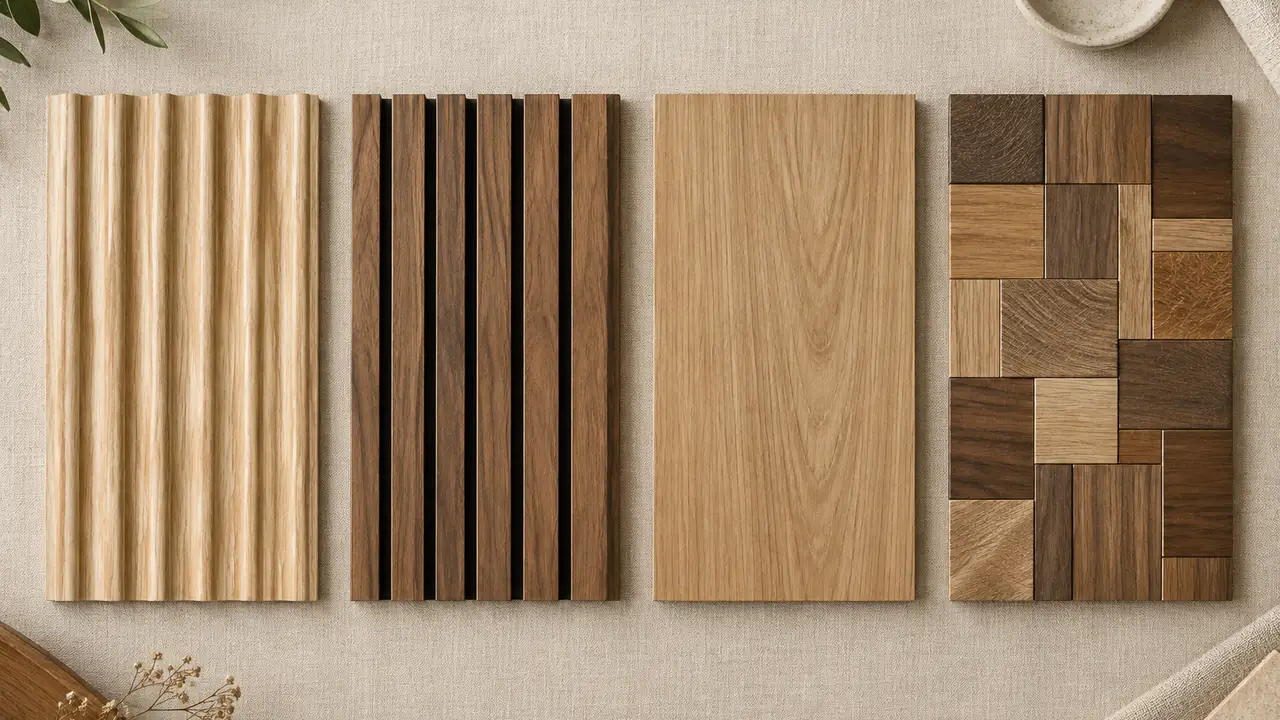
What a mosaic panel is
A mosaic wood panel is a composition: solid wood blocks or veneer-faced tiles are laid into a repeating pattern and carried on a panel or a sheet, so an installer hangs one product and a wall receives a hundred pieces of design. The pattern families that dominate export ranges are hexagon - blocks or tiles in a honeycomb grid - chevron, angled strips meeting at a rising line, and the three-dimensional cube, blocks shaded or cut so the face reads as stacked cubes. Typical category modules run from 300 x 300 mm up to 1200 x 600 mm per spec sheet, and the module is the single most consequential number on the order, because it fixes the joint lines the installer and the customer will live with.
The buyer for this line wants a feature that no fluted wall can deliver: pattern as the brand moment. DTC brands use it for launch visuals and content shoots; retail and hospitality use it behind reception and bar fronts; marketplace sellers use it where a wall must earn attention in a photograph. The accent wall note covers the scale questions, and mosaic is the family where scale discipline matters most.
Patterns and modules
| Pattern | How it is built | Where it reads best |
|---|---|---|
| Hexagon | Blocks or tiles laid in a honeycomb grid, grain running with each cell | Feature walls, bar fronts, brand backdrops |
| Chevron | Angled strips cut and laid to meet at a continuous rising line | Reception walls, headboards, hall accents |
| Cube, three-dimensional | Blocks shaded, beveled or cut so the face reads as stacked cubes | Retail features, content walls, photo backdrops |
| Modules | Panel sizes from 300 x 300 up to 1200 x 600 mm per spec sheet | Grid planning before ordering, joint alignment on the wall |
The module math is where programs are won. A 300 x 300 module tiles a wall in tight, busy joints; a 1200 x 600 module reads as calm panelling with pattern inside it. Before ordering, lay the module over the wall drawing and decide where joints land - at door casings, against window reveals, around sockets. A five-minute grid check prevents the most common mosaic complaint: a pattern that starts in the corner and dies in the middle of the feature wall.
Faces: solid blocks versus veneer tiles
Two face constructions share the pattern families. Solid wood blocks carry the material story of the solid family - honest end grain, tactile depth, repairable surfaces - and they behave like solid wood: conditioned to roughly 8-12% moisture content per destination climate, sealed on all faces, happiest indoors away from wet zones. Veneer-faced tiles bring the veneer family's economy and batch repeatability to the same patterns: engineered faces repeat cleanly across batches, which matters enormously when a pattern must match across a whole wall and a later extension. Neither is better; the choice follows the same logic as the flat families, and the veneer versus solid note carries over almost word for word.
Tone planning is the craft here. Patterns work because adjacent pieces differ - in grain direction, in tone, in relief - and a plant that shades blocks deliberately produces a wall with depth, while a plant that assembles same-tone pieces produces wallpaper made of wood. Ask to see two production lots photographed side by side before approving a color; the difference between shading discipline and assembly-line tone is visible in one photograph.
Backing, mesh and mounting
Mosaic products arrive in one of two ways: as full panels with the pattern bonded to a carrier, or as sheet-mounted tiles on a mesh or paper face for direct adhesive fixing. Panels go up like any wall panel - battens, rails or adhesive per the drawing - and keep the feature removable; mesh-mounted sheets go up like tile, which suits columns, insets and curved returns that panels cannot follow. The fixing decision should be made before ordering because it changes the product bought, and the installation systems guide compares the routes. Trim planning finishes the job: edge profiles and transition trims from the same color ladder, counted as line items in the original order, keep the cuts at sockets and returns reading as details rather than as repairs.
Batch discipline for pattern programs
Mosaic is the family where batch consistency is least forgiving, because pattern draws the eye to every misplaced cell. The retained-swatch discipline of the flat families applies, plus two more checks. First, pattern registration: the repeat must land the same way on every panel or sheet, so the grid on the wall is continuous - check it by butting two panels from the same lot under good light before installation starts. Second, tone distribution: the mix of light and dark pieces should be the plant's documented standard, not an accident of assembly, and it should be checked per lot against the approved sample. The batch matching note shows how retained standards are checked under a standard lamp; mosaic adds the grid to that photo.
Quantities, samples and lead time
Mosaic lines commonly start around 100-200 sq m across the category, confirmed in writing per program; the typical ranges sit on the MOQ and lead time page. Panel samples typically take 7-15 working days, and a custom pattern or tone adds a proofing stage - commonly 15-25 days for the sample - before any production run, because the shading standard has to be approved and frozen first. Bulk production for veneered-family lines typically runs 25-45 days. Packaging deserves respect in this family: small pieces, many edges, so corner-protected cartons and a crate plan that keeps heavy stock off mosaic cartons are part of the quality, and the desk coordinates that plan per order.
What to ask a partner plant
- Which pattern families run as standard tooling, and which are assembled to order - and how that changes lead time.
- What modules the plant offers in each family, and whether the drawing can be grid-checked against them before ordering.
- Whether the face is solid blocks or veneer tiles, and what the conditioning class and sealing are for the destination climate.
- How tone distribution is specified and checked, and what the approved shading sample looks like per lot.
- Whether the product is panel-backed or mesh-mounted, and what fixing method each assumes.
- How the repeat is registered across panels, and what the plant does when a wall needs a half module at an edge.
- What the written confirmation covers: area per pattern, module, documents, and the repeat-order lane.
How the desk frames a mosaic program
A mosaic program through this desk starts with the wall drawing, not the sample book: the grid is laid over the drawing, joints are placed on purpose, and the module is chosen before any pattern is sampled. The desk then shortlists partner plants by pattern family and face construction, orders samples against the retained shading standard, and freezes module, tone mix and documents in writing before bulk. Emission certificates for cores and adhesives follow the same frameworks as every composite line - CARB Phase 2 alignment with EPA TSCA Title VI, or E0/E1 under GB/T 39600, per lot - verified per project. When the grid and the shading standard are drafted, the quote form puts pattern, module, area and certificates in front of the shortlist at once, and the desk returns options with the assembly records each plant holds best.