
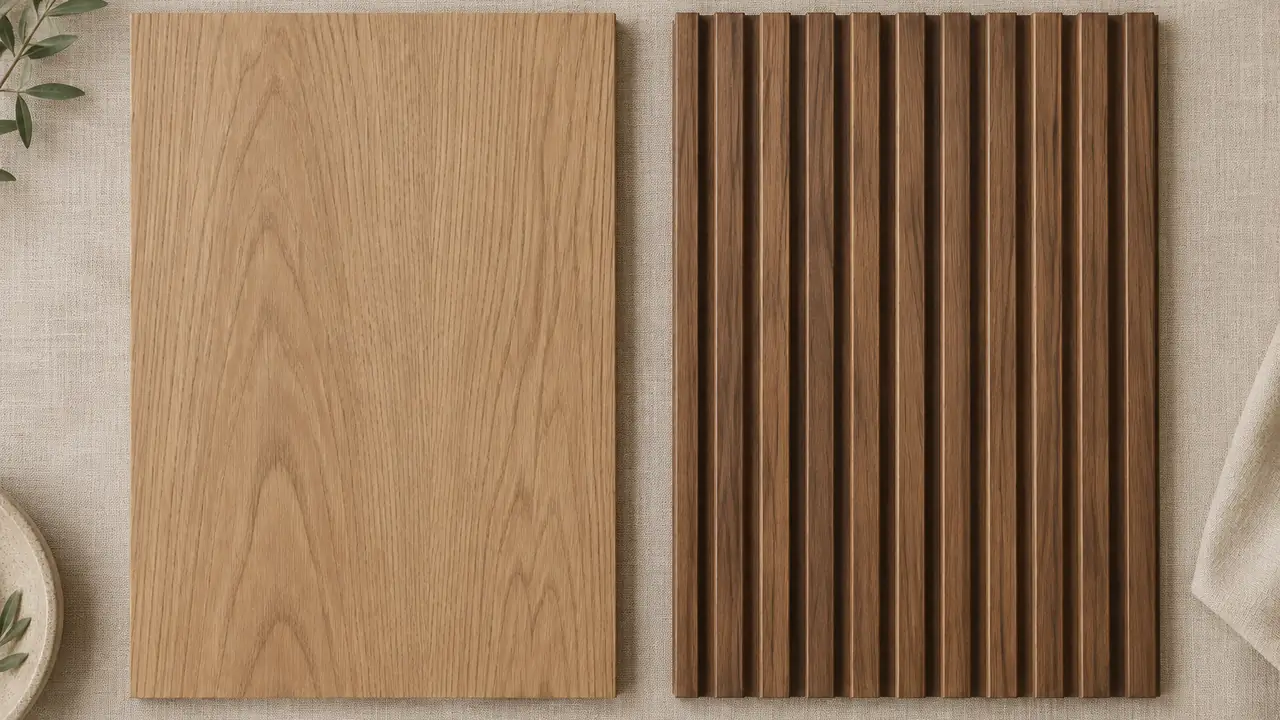
Format is a logistics decision wearing a design hat
Ask for the wrong format and the mistake does not surface in the warehouse. It surfaces at the joint line where the grid meets the ceiling, at the container quote where air ships instead of panel, and at the refit three years later when the matching piece has to be found. Formats are chosen for walls and for containers at the same time, because both have arithmetic, and the two arithmetics disagree more often than buyers expect. A program that treats format as a logistics decision from the first sketch avoids most of it.
The two dominant philosophies in decorative wall panels are the flat sheet - the industry's 1220 x 2440 mm canvas - and the modular panel: profile strips at 2400-2900 mm or tiles from 300 x 300 mm upward. Both ship worldwide in serious volume; this note compares them on grids, freight, damage profile and range planning.
The 4x8 world
Flat veneer panels speak the language of the sheet. The default canvas is 1220 x 2440 mm - four feet by eight - with thicknesses from 3-18 mm per spec sheet, and it is how flat panels are produced, stocked and shipped across the category. The sheet is the common denominator: wall grids are drawn to it, crating is engineered for it, and pallets stack face to face with edge protection in dense, flat stacks that fill a container efficiently. Sheets reward scale and flatness: a lobby wall is a few pallets, and joints fall where the drawing puts them - centered, hidden in a shadow gap, or aligned with an architectural line that makes the joint read as intent.
The format also carries obligations. Anything longer or wider than the sheet needs a joint plan before sampling, not on site; handling wants two people or a panel lifter at the larger sizes; and face protection in transit matters more, because one scratched sheet is a visible defect across a large area rather than one small tile. None of this is difficult; all of it belongs in the order.
The modular world
Modular panels trade canvas for rhythm. Profile lines - fluted and slat - ship as strips commonly 2400-2900 mm long by 120-160 mm wide, boxed as lengths with corner protection; mosaic lines ship as tiles in modules from 300 x 300 mm up to 1200 x 600 mm, packed in small cartons. The modularity is the point: installers cover a wall strip by strip or tile by tile, corners turn without a cut sheet, odd widths absorb into the rhythm, and a damaged piece is replaced one module wide. Ceilings and curved or broken layouts favor the smaller formats for exactly these reasons.
The obligations are counting and protection. A modular wall is a parts list - strips per row, tiles per square meter, trims per run - and the crate plan should mirror the install sequence, because the second pallet is useless in hour one if the first wall needs it last. Small cartons also stack badly under heavy loads, which makes the packing plan a real document rather than a courtesy. The mosaic panel line shows the module options and their grid logic.
The two formats side by side
| Aspect | 4x8 flat sheets | Modular panels |
|---|---|---|
| Typical formats | 1220 x 2440 mm; 3-18 mm | Strips 2400-2900 x 120-160 mm; tiles 300 x 300 to 1200 x 600 mm |
| Wall grid | Joints planned on the drawing | Rhythm absorbs corners and odd widths |
| Packing | Pallets face to face, dense stacks | Boxed lengths; small tile cartons |
| Damage profile | Face scratches across large areas | Corner chips, carton crush |
| Install speed | Fast coverage, needs jointing skill | Rhythmic, forgiving, more repetitions |
| Repair unit | A full sheet | One strip or one module |
| Reference minimum | 100-300 sq m per color | About 100-200 sq m per color, per program |
| Strongest fit | Large flat statements, matched grain | Feature rhythm, ceilings, broken layouts |
Ranges are the category's typical figures; the spec sheet of the actual lot decides. Both formats can carry the same color ladder, which is how mixed ranges stay coherent while shipping differently.
Container math and the damage ledger
Freight favors different formats at different mixes. A 40-foot high-cube container carries roughly 800-1,200 sq m depending on thickness and packaging style, and flat sheets sit toward the efficient end of that band when palletized dense and uniform. Modular loads lose some fill to cartons, voids and bracing, and mixed-format programs lose a little more - the price of flexibility, worth paying when the range needs it. Transit adds its own calendar: sea freight to North America's west coast commonly runs 15-25 days and to Europe 30-45, per the logistics page, which is why the crate plan and the install sequence are agreed before sailing, not after arrival. The damage ledger differs too: sheets risk face scratches that show across square meters, modules risk corner chips that show up close - and packaging answers each differently, as the container planning note details.
Grids, joints and install reality
On the wall, the formats impose different disciplines. Sheets need a jointing rule decided in the drawing: where joints fall, how they read, what trims close them. Modules need pitch discipline instead: alignment across adjacent panels, level starting rows, and reveals that read as rhythm rather than as drift. Both want the fixing route agreed early - rails, battens or adhesive - and the installation systems guide covers the three for either format. Install speed is genuinely different: sheets cover area fast once the jointing is solved; modules move at the pace of repetition but forgive imperfect walls, which is why renovation sites often choose them. The sizing and modularity note walks the grid arithmetic in full.
Reference quantities and production windows for both formats are listed on the MOQ and lead time page, confirmed in writing per program. When the format decision is made, the quote form carries the wall grid, the area and the crate preferences together, so partner plants quote a shippable program rather than a number of square meters and a question mark.