
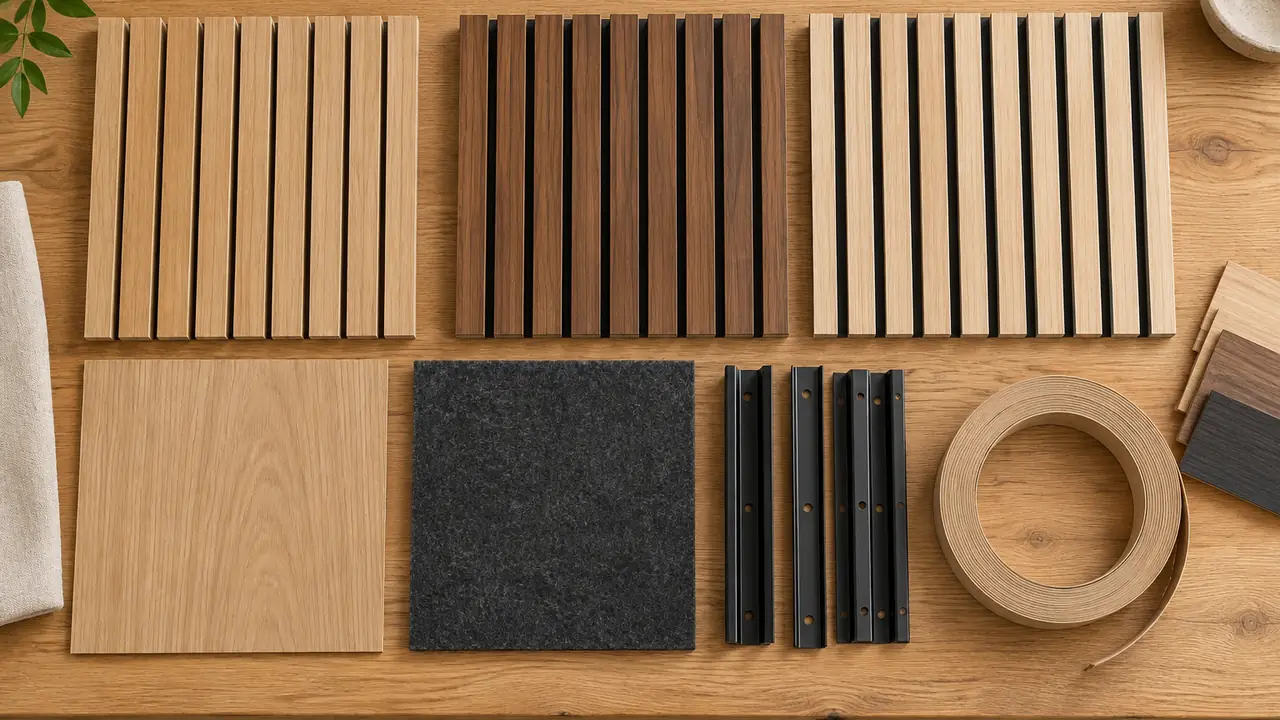
The layer doing the quiet work
Buyers who treat the felt as packaging miss the point of the product they are paying an acoustic premium for. The felt - typically recycled polyester, commonly 9-12 mm thick across the category - is the porous layer sound actually enters; the slats shape the openings that let it in and give the wall its rhythm. Buyers who treat it as a magic layer, on the other hand, believe more than any test report says. The honest position sits between: the felt makes absorption possible, and the measured number belongs to the tested configuration, not to the material name. That single distinction governs everything a buyer should confirm about this component.
The felt is also a commercial layer, not only an acoustic one. It carries the color of the gaps between slats, it adds thickness and weight to every carton, and its quality shows up years later as either a stable bond or a wall of lifting strips. This note walks the felt as a specification: what it is made of, the two numbers that matter, the documents behind each claim, and the checks that catch real failures before a container ships.
What PET felt is made of
PET felt is needle-punched polyester sheet, most often produced from recycled bottles, cut and bonded to the back of slat panels in factory lamination. The recycled content is one of its selling points, and it is a claim with paperwork attached: the percentage belongs to the plant and travels as a declaration with supporting documents, which the desk verifies per program before any listing repeats the figure. Color runs through the material rather than sitting on a surface, so panel edges cut cleanly and the gaps between slats read as one calm dark field - one of the reasons PET displaced older backings in decorative panels. It is also light for its thickness, which keeps wall loads and freight sensible, and it tolerates cartons, clamps and stairwells in a way that exposed mineral fibers never could.
Thickness, density and what they change
Two numbers matter on a spec sheet. Thickness commonly sits in the 9-12 mm band on export slat panels; moving within that band changes the panel's overall gauge, its weight per square meter and how much porous depth sound sees. Density shapes how the felt resists compression during stacking and how it handles at the edge banding and cutting stations; both figures belong to the spec sheet per model, and the desk treats them as program decisions rather than per-order whims, because a mid-program switch changes freight, edge detail and sometimes the acoustic report the listing cites. A thicker felt is not automatically a better one: the published absorption number comes from the whole build - slat pitch, felt thickness, cavity behind - tested together as one configuration.
The claims that travel with felt
Absorption: slat panels with PET felt commonly publish NRC values in the 0.75-0.85 band, measured to ASTM C423 or ISO 354 for the tested configuration, and the NRC guide explains how to read and defend that figure. Fire: where a listing names a class, the class comes from a test on the build-up - ASTM E84 in North America, EN 13501-1 in Europe - stated per test report; the felt itself is not fireproof and this desk does not use that word. Chemistry: buyers serving the European Union sometimes ask about REACH for material inputs, and the professional answer is a document request to the plant, not a slogan. Health claims of any kind are off the table: felt manages sound mechanically, and the desk describes it no other way.
Quality checks that catch real failures
Felt fails in visible, testable ways. Bond first: strips lifting off the felt - the delamination story the delamination note covers in detail - usually trace back to adhesive choice or press discipline. Cutting second: panel edges should come off the saw clean, without fuzz or pull-out that would show at every site cut. Color third: consistency against the retained standard across lots, because the felt's tone changes how the whole wall reads more than buyers expect. Compression fourth: whether the felt recovers after carton stacking, since a crushed band reads through the slat rhythm. None of these need a laboratory on site; they need an inspection plan agreed before production, which is the argument the quality control page makes across every component in the catalogue.
| Spec line | Typical across the category | Confirmed by |
|---|---|---|
| Thickness | 9-12 mm on export slat panels | Spec sheet per model |
| Density | Stated per plant spec sheet | Spec sheet per model |
| Recycled content | Declared by the plant | Declaration plus documents per program |
| Color | Usually dark tones, per color card | Retained standard per lot |
| Absorption | NRC 0.75-0.85 band for tested slat builds | Test report per configuration |
| Fire class | Where listed: per tested build-up | ASTM E84 or EN 13501-1 report |
Felt as a freight and BOM decision
Felt adds thickness, weight and carton volume, and those additions multiply across a container. A 40-foot high-cube carries roughly 800-1,200 square meters of paneling depending on thickness and packaging style, and felt-backed panels sit toward the lower end of that band. Deciding the felt early therefore decides the container plan, the per-unit freight share and the crate list - which is why the desk asks the backing question in the first conversation rather than at artwork approval. The container planning note works the arithmetic for mixed loads, where slat panels, trims and hardware share the same box.
What to confirm in writing
Four sentences close a felt specification: thickness and density per the spec sheet; recycled content as a plant declaration with documents; absorption cited only from the test report for the exact build; and a fire class cited only where a report exists for the build-up. The desk keeps those four lines beside the retained color standard for the life of the program, checks them at pre-shipment inspection, and re-confirms them on every repeat order. Reference minimums for slat programs start around 100-200 square meters per color across the category, confirmed in writing per program on the MOQ and lead time page; the quote form collects the build details and partner plants answer with the documents that back them. Components like this reward the buyers who ask for paper: the wall looks the same either way, and only the documents know the difference.