
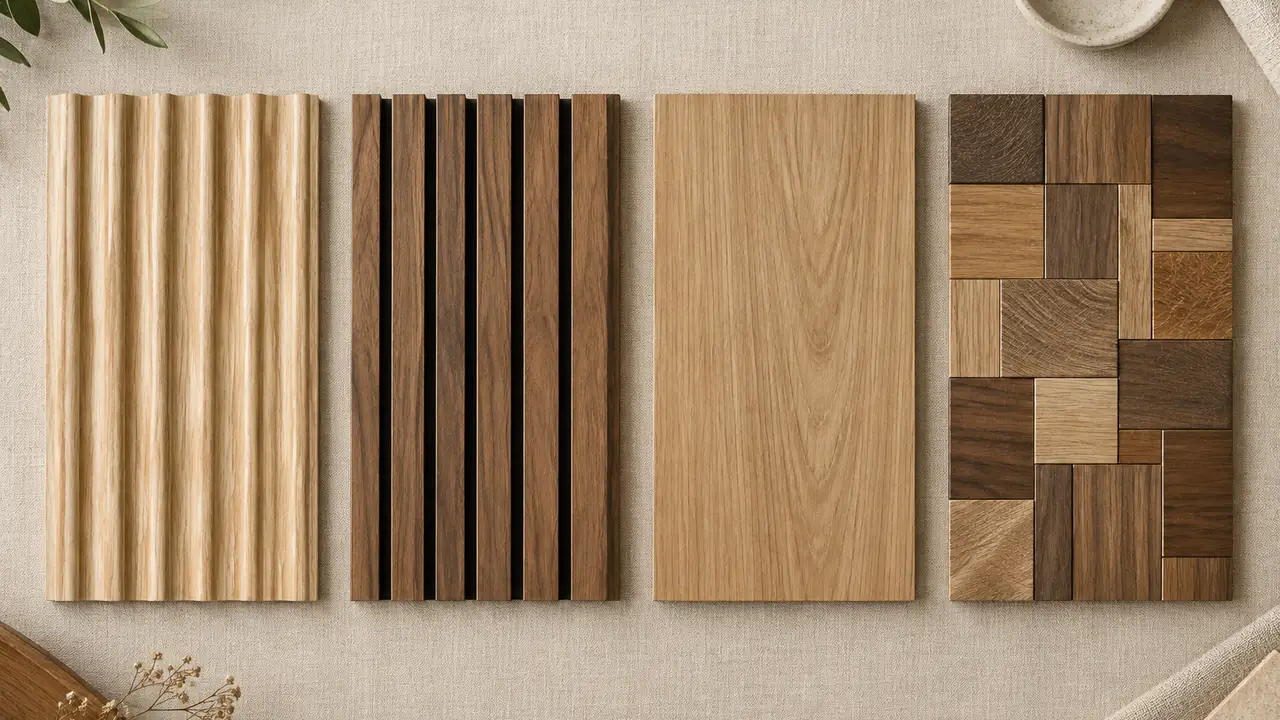
What a veneer panel is
A wood veneer panel is a sandwich. A face of natural or engineered veneer - sliced at roughly 0.3-0.6 mm - is bonded to a core of MDF or plywood, in the standard 1220 x 2440 mm sheet format that the trade calls 4x8, at thicknesses from about 3-18 mm per spec sheet. The core does the dimensional work; the face does the aesthetic work; the glue line holds the argument between them. Because the face is thin, a large wall can carry one continuous grain story - book-matched leaves unfolding across a reception - which solid timber at panel scale cannot do at a sensible weight or cost.
The audience for this line is the buyer who cares how a surface reads up close: brand backdrops, wardrobe and joinery fronts, lobby walls, conference rooms, ceilings where weight matters. The veneer sheets line is the same material in roll and sheet form for buyers who veneer their own substrates, and the two are often sourced in the same program so walls and details share one grain story.
Natural or engineered: the face decision
Natural veneer is sliced from real flitches, and it behaves like wood: knots, mineral lines, color drift from one leaf to the next. That drift is not a defect - it is the material - but it must be planned, because two panels from different leaves can read as different species under raking light. Engineered veneer is reconstituted from real wood, dyed and laid to repeatable patterns, and its virtue is predictability: the forty-first panel matches the first, and a refit two years later matches both. Neither is better. A program should decide which it is buying and state it on the spec, because the batch plan - and the promise a listing can make - follows from that single choice.
The practical test at sampling is simple: ask for panels from two different production lots, not two panels from the same box. A plant confident in its batch discipline sends them without hesitation; the color matching note explains how the check is run under a standard lamp against a retained swatch.
Matching methods and the drawing
Matching is where veneer panels stop being a commodity and become a design decision. Book match opens adjacent leaves like a mirror for symmetric, dramatic grain; slip match lays leaves in sequence for a flowing, non-mirrored repeat; random match mixes leaves for a calmer, less formal surface. The matching note shows all three on one wall drawing. What matters commercially is that the method is named in the order, because the method decides how leaves are clipped, jointed and pressed - and therefore how many square meters of usable face a flitch yields. A program that specifies book match on every panel pays for the yield it consumes; a program that reserves book match for the feature wall and slips the rest spends the same flitch much further.
Sequence planning belongs here too. Numbered panels, installed in the order they left the press, keep the grain story continuous; a crate list that mirrors install order is part of the matching plan, not a logistics afterthought.
Grades and glues
Two document families decide what a veneer panel listing is allowed to say. The first is emissions, and it lives in the glue line and the core: E0/E1 urea-formaldehyde systems or, in some builds, PUR adhesive, certified to E0/E1 or ENF under GB/T 39600 for markets that read it, or to CARB Phase 2 alignment with EPA TSCA Title VI for the United States, per third-party certificate held by the plant per lot. The honest language is a named grade with a certificate behind it - never a zero-formaldehyde claim, which this desk does not make. The grades guide lines the frameworks up.
The second family is the sandwich evidence itself: adhesion. Veneer peeling is the classic failure of a badly pressed panel, and it is preventable - the peeling note lists the causes. The checks a program agrees in advance typically include veneer adhesion, surface resistance to scratching and staining, thickness tolerance, and color against the retained swatch; the testing and inspection page shows how they are organized.
| Choice | Options | What it moves |
|---|---|---|
| Face | Natural veneer, engineered veneer | Grain story versus batch repeat; sampling plan |
| Core | MDF, plywood | Flatness versus screw holding and weight |
| Adhesive | E0/E1 urea systems, PUR | Emission grade, bond quality, press discipline |
| Matching | Book, slip, random | Pattern continuity, flitch yield, cost shape |
| Thickness | 3-18 mm per spec sheet | Weight, ceiling use, edge detail |
| Emission grade | CARB P2 / TSCA alignment, E0/E1/ENF | What the listing can claim, per certificate |
Quantities, samples and lead time
Veneered wall panels commonly start around 100-300 sq m per color across the category, confirmed in writing per program; the typical ranges sit on the MOQ and lead time page. Sampling runs: color cards in roughly 5-10 working days, panel samples in roughly 7-15 working days, and a custom matched tone in roughly 15-25 days for the proof alone. Bulk production typically runs 25-45 days, with a longer first run where a custom color or an unusual matching plan is involved. A 40-foot high-cube container carries roughly 800-1,200 sq m depending on thickness and packaging; flat sheets pallet face-to-face and fill efficiently, which is one reason this family freights well.
What to ask a partner plant
- Which cores run on which press lines, and what the thickness tolerance record looks like per lot.
- Whether the flitch or the engineered pattern for a color is reserved for the program, so refits match.
- Which matching methods the plant is strongest at, and how leaf yield is planned against the drawing.
- Which emission certificate the build carries per lot, and whether the certifier is recognized in the destination market.
- How adhesion is tested and recorded, and what the retained swatch discipline is for the approved face.
- How panels are numbered and crated relative to install order, so the grain story survives the journey.
- What the written confirmation covers: area per color, matching method, documents, and the repeat-order lane.
Where veneer panels earn their keep
The line wins wherever a large surface must read as one composition: reception walls with book-matched figures, wardrobe fronts that continue the wall they sit in, conference rooms where the grain is the brand. It pairs naturally with the fluted and slat families from the same tone ladder - veneer where the surface should whisper, profiles where it should keep rhythm. Program structure matters more here than in any other family: the face decision, the matching plan and the swatch discipline are what turn a wall of sheets into a range a brand can extend for years. When those three are drafted, the quote form puts the brief - face, core, matching method, certificates - in front of shortlisted plants at once, and the desk returns options with the flitch and press documentation each plant holds best.