
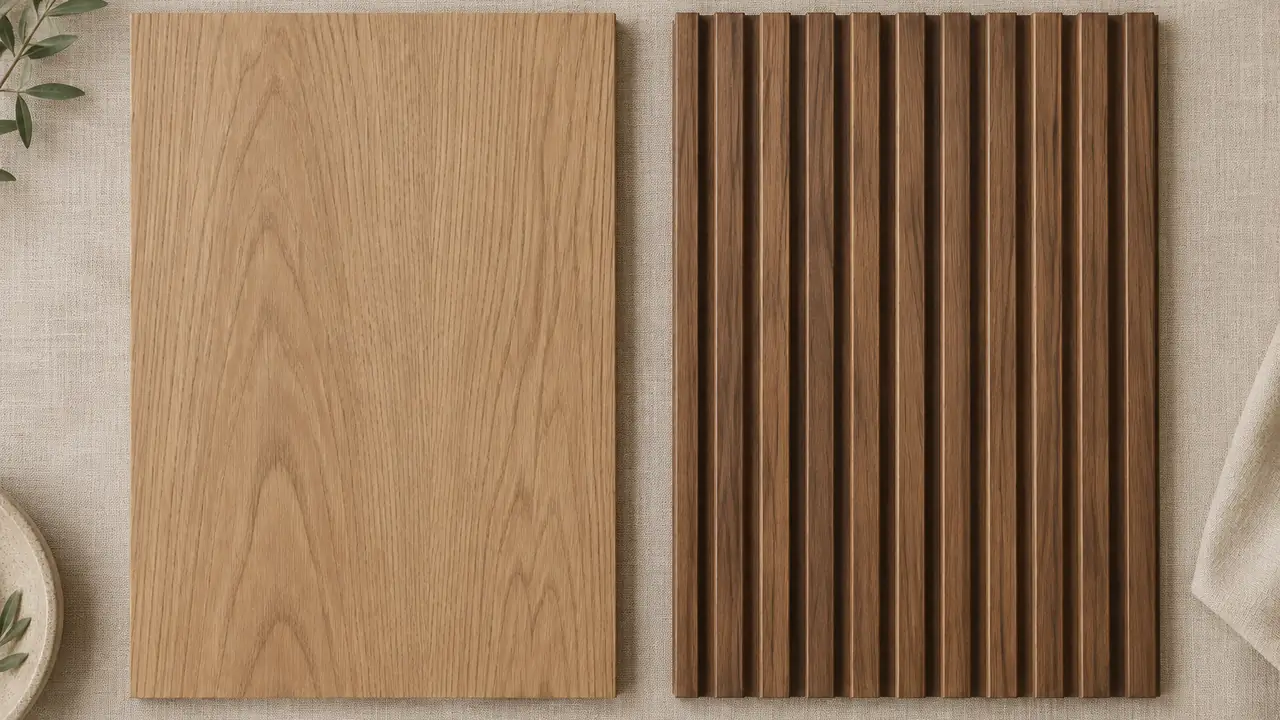
Why the core is a buying decision, not a detail
Two panels with identical faces can behave like different products because of what is underneath. The core sets flatness - whether a wall reads as machined calm or telegraphs every uneven batten. It sets weight, which matters on ceilings and on partition walls with load limits. It sets screw holding, which matters wherever cabinets, TV brackets or handrails land on the panel. And it carries the adhesive system that determines which emission grade a certificate can name. Yet in many quotations the core appears as one unexplained line, or does not appear at all, which is exactly how programs end up with the right look and the wrong panel.
This note describes each core as it is actually made and used, compares them for wall work, and closes with the applications where each one is the right answer. The comparison covers interior decorative panels - the fluted and slat lines, flat veneer builds - rather than structural sheathing, which is a different product conversation entirely.
MDF: the flat, machinable default
MDF is made by breaking wood into fibers, blending them with resin and pressing them into dense, uniform, homogeneous sheets. That homogeneity is its talent: the board is the same through and through, so it machines into crisp flutes and slat strips without splintering, holds a veneer face perfectly flat, and presents a smooth, even surface to any finish. It is the default body for profile panels - the fluted line's 12-22 mm bodies are typically MDF - and the common core for flat veneer panels in the 3-18 mm range. Its density is also its cost in freight: at equal thickness it is heavier than plywood, which adds up on large programs and on ceiling builds. For humid rooms - kitchens, bathrooms, coastal interiors - moisture-resistant MDF is the upgrade tier, using a different resin package that earns its premium where ordinary board would swell at an exposed edge.
Plywood: layered strength and lighter weight
Plywood stacks thin wood veneers with the grain of each layer rotated against the next, pressed into a board whose cross-laminated structure resists splitting and holds screws remarkably well. In wall panel terms it buys three things: screw holding where fixtures bite repeatedly, lighter weight at equal thickness - welcome on ceilings and on retrofit walls - and better performance at exposed edges, where the layered edge can be detailed as a design feature. The trade is surface and machining: a plywood face is less uniform than MDF, so it usually wants a cross-band or a thicker veneer to present a perfect surface, and machined profiles into plywood demand sharp tooling and a willing plant. It is the natural core behind heavy fixtures, on ceiling grids, and anywhere the panel is also the structure's fixing ground. For buyers comparing quotations, the layup matters as much as the name: ply counts, face grades and the adhesive all appear on a spec sheet, and two plywood cores at the same nominal thickness can behave differently on a wall.
The two cores side by side
| Aspect | MDF core | Plywood core |
|---|---|---|
| Structure | Homogeneous pressed fiber | Cross-laminated wood veneers |
| Flatness | Excellent; ideal under thin veneers | Good; wants cross-band for fine faces |
| Machining | Crisp flutes and slats, clean edges | Needs sharp tooling; layered edge shows |
| Screw holding | Adequate; correct fixings matter | Strong; layers grip fixings well |
| Weight | Denser at equal thickness | Lighter at equal thickness |
| Humidity tier | Moisture-resistant MDF upgrade | Marine-type variants per spec sheet |
| Cost drivers | Fiber price, resin package, thickness | Veneer grade, layup, thickness |
| Strongest fit | Profile faces, large flat walls | Ceilings, fixture-bearing walls |
Thickness behavior follows each family: profile bodies commonly run 12-22 mm, flat veneer builds 3-18 mm, per spec sheet. The core choice does not change those ranges; it changes how each thickness behaves on the wall.
One more interaction belongs in the brief from the start: the fixing system behind the panel. Battens forgive MDF's density with screws at closer centers; rail systems with clips want a core that bites reliably, which is plywood's home ground; adhesive routes care less about the core itself than about the flatness it preserves over seasons. Deciding the core and the fixing route together - in the same email, on the same drawing - is one of those unglamorous sequencing habits that keeps an installation crew from improvising on site, and it costs nothing at quotation stage.
Where grades and glue enter the picture
The emission grade a listing can name is a property of the core and its adhesive, which makes the core choice a compliance choice too. Both core families certify: E0/E1 under GB/T 39600 for markets reading the Chinese and European frames, CARB Phase 2 alignment with EPA TSCA Title VI for the United States, certified by approved third parties and documented per lot; in Europe, EN 13986 governs conformity assessment for wood-based panels used in construction. The grades guide lines the tiers up. What the core cannot do is make a panel compliant by reputation - the certificate travels with the lot, and the desk verifies it per project, whatever the board family.
Choosing per application
The practical decision rule is short. Large flat walls and machined faces: MDF, because flatness and crisp profiles are the job. Ceilings and long spans: plywood leans in, because weight per square meter is the budget that matters - the weight and handling note has the numbers' logic, and the ceiling note the fixing consequences. Walls that will carry cabinetry, brackets or rails: plywood where screws bite often, or a fixing plan - blocking, rails from the installation systems guide - that puts the load into the wall rather than the board. Humid rooms: moisture-resistant MDF as the default tier, plywood variants where the spec asks. Mixed programs can mix cores; the discipline is to say so on the spec sheet, so inspection checks each build against its own standard rather than one shared assumption.
Reference quantities and timing stay as the category's typical ranges - veneered and profile lines commonly start around 100-300 sq m per color, bulk production 25-45 days - confirmed in writing per program on the MOQ and lead time page. Programs that state the core on the drawing also skip the classic argument at inspection, where a thinner or lighter substitution is invisible on a pallet and obvious on a wall once the fixtures go in. When the core decision is made, the quote form records it alongside face, thickness and certificates so two or three partner plants quote the same build rather than two adjacent ones.