
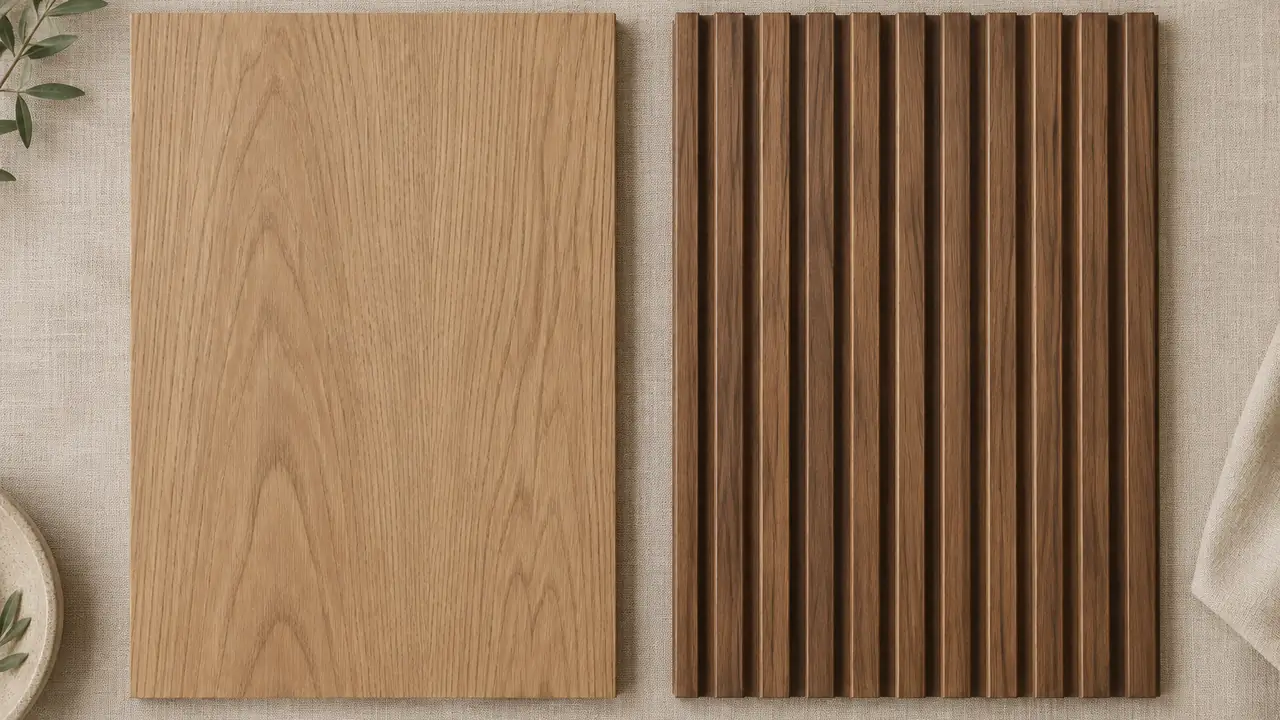
Two shapes for a first range
Brand owners arrive at this desk with the same fork in the road. One path launches a single line - usually fluted or acoustic slat - carried deep in a few colors, learned thoroughly, sold confidently. The other launches a range: a slat line for sound, a flat veneer line for brand walls, perhaps a mosaic accent, each thinner in volume but together covering more of a customer's wall. Both shapes exist across the category for good reasons, and neither is the beginner's route by default. The choice is really about how much operational complexity a team can hold while it is still learning its market, and what the first container is supposed to prove.
This note compares the two shapes on the things that actually bite: area minimums, container fill, sample programs, batch discipline and the story the range tells. The two most common first lines illustrate it well - the fluted panel line and the acoustic slat panel line - and the logic extends to every other family on the types guide's map, the wood panel types guide.
What one line buys
Depth is the argument. Concentrating the first order on one line pushes each color toward comfortable production quantities - veneered and profile lines commonly start around 100-300 sq m per color across the category - which earns attention from the plant, steadier press scheduling and better batch discipline. Operations simplify to one swatch set, one grade file per build, one inspection plan, one crate style. The team learns one product deeply: its installation habits, its customer questions, its spare-parts profile. And the brand story stays sharp, because one line is easy to explain in a listing, a showroom and a sales call alike.
The limits are exposure and shelf narrowness. One line bets the program on one demand signal; if the market's taste moves, the range has nowhere to move with it. Cross-selling is thinner too - a customer buying a feature wall has no matching ceiling or furniture-grade surface to add - and a competitor with a fuller catalog can answer questions the single-line brand has to decline.
What a multi-line range buys
Breadth is the counter-argument. A range that pairs rhythm with flat surfaces - slat where people gather, veneer where brands speak, mosaic where accents land - meets more briefs per conversation and reads as a house rather than a product. Risk spreads across demand signals: the line that slows cushions the line that runs. Components deepen the story further; rails, felt and trims documented on the components hub turn a panel range into an installable system, which project buyers notice and marketplace sellers can bundle.
The price is arithmetic and attention. Every line carries its own minimums, its own swatch set, its own plant competence and often its own plant - and each color within each line is its own production run. A team that launches three lines is really launching six or nine small programs wearing one brand. Samples multiply, documents multiply, and the desk's job - coordinating lots so one line's delay never holds a container - becomes the difference between a range and a pile.
The arithmetic side by side
| Aspect | One line, run deep | Multi-line range |
|---|---|---|
| Area per color | Concentrates toward 100-300 sq m minimums | Splits area; each line meets its own minimum |
| Container fill | One build packs efficiently toward 800-1,200 sq m | Mixed loads fill less; crate plan carries it |
| Sample program | One ladder, one color card | A ladder per line; budget and courier multiply |
| Batch discipline | One swatch set, one inspection plan | A standard per line; coordination decides |
| Brand story | Sharp and single-minded | A house; more briefs answered |
| Operational load | Learnable by a small team | Real project management, from day one |
| Strongest fit | First containers, focused brands | Established sellers, project and retail buyers |
The table reads as a sequencing tool more than a verdict: most ranges that last started as one line that earned its depth first.
Container and minimum math
The arithmetic decides more arguments than taste does. A 40-foot high-cube container carries roughly 800-1,200 sq m depending on thickness and packaging, so a single-line launch with four or five colors can fill a container with colors at healthy depths - every color above its minimum, every lot worth inspecting. Split the same area across three lines and each color drifts toward its floor: minimums are met, but thinly, and thin lots get thin attention on any factory floor. Mixed-line containers also pack less efficiently, which the container planning note covers in detail. None of this forbids a multi-line launch; it prices one. Teams with distribution commitments or project pipelines often hold that price gladly. Teams proving a market usually let the first container teach them which line deserves the second. Reference windows for both shapes are on the MOQ and lead time page, confirmed in writing per program.
Operations: samples, swatches, spares
Behind every line sit the same recurring costs, multiplied by the count of lines. Sampling: a color card runs 5-10 working days and panel samples 7-15 across the category, per line. Documentation: each line carries its own build file - core, adhesive, certificates per lot. Spares: after-sales wants a panel per color per line held back before shipment. Trims: rails, edge banding and end caps are counted per drawing, commonly ordered by the thousand pieces, per line. A single-line program holds all of this in one spreadsheet row; a three-line program holds three, plus the coordination between them. The honest self-question is not whether the team can afford the samples but whether it can answer three plants' questions in the same week it answers its own customers - which is precisely what a sourcing desk exists to carry, and why multi-line programs usually arrive here rather than going it alone.
A staging plan that starts with one
The pattern that works for most launches: begin with one line in a small core ladder of colors chosen for the market's center of gravity, run it deep enough that every lot is healthy, and instrument it - which colors move, which questions come back, which rooms buyers name. The brand line note walks that build-out. Add the second line when the first one's repeat orders argue for it: slat beside fluted for sound-led briefs, veneer beside profile for brand walls, components once installers start asking. Each addition reuses the muscle the first line built - the swatch discipline, the document set, the inspection rhythm - so the second line starts with experience rather than with hope. When the staging plan is written, the quote form turns it into plant options: line one first, line two costed as a follow-on, so the range grows on a calendar instead of on an impulse.