
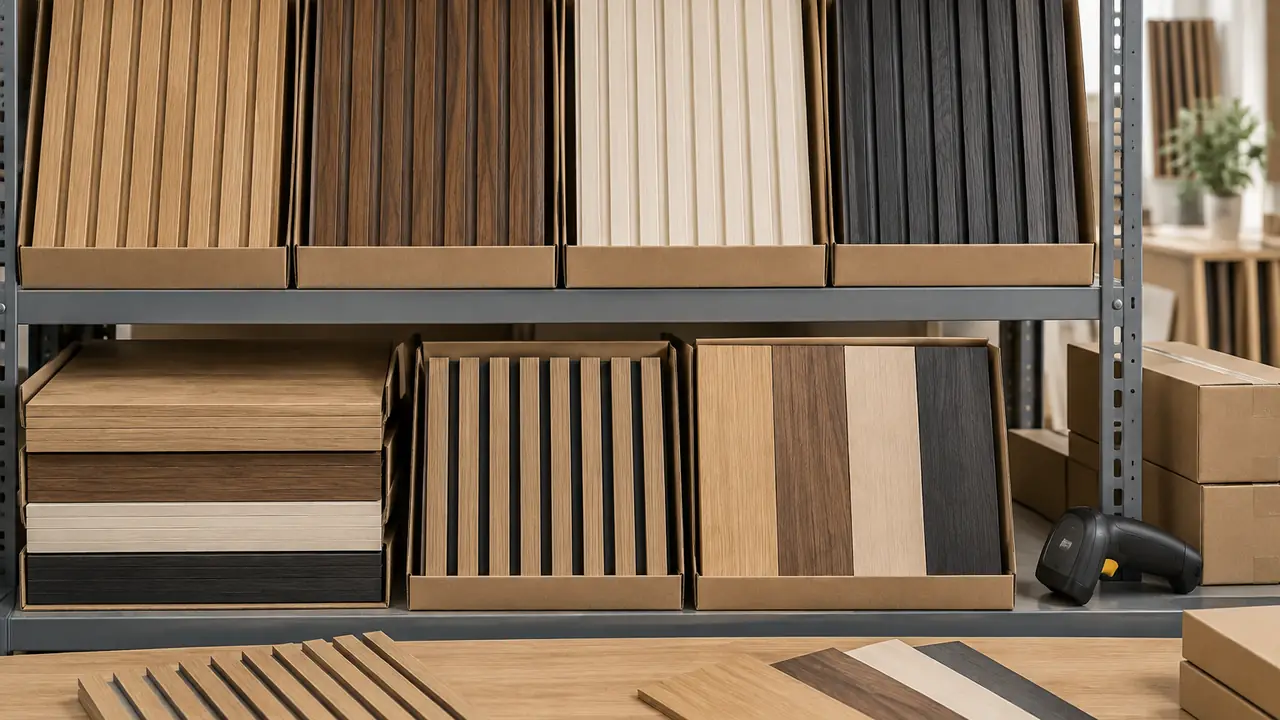
What a brand line means in panels
In decorative panels, the brand lives in repeatable specifics: colors that match between orders, documents that arrive with the lots, packaging that survives the lane, and an after-sales answer that comes from a register rather than a memory. Those are sourcing decisions before they are marketing ones, which is why brand building in this category starts at the plant shortlist and works forward. A brand line, concretely, is a family of products, a frozen color ladder, a swatch book, a document set, a packaging spec and a service plan - each named, each owned, each confirmed in writing. Anything less is a reseller with a font, and the market prices the difference quickly.
Step one: choose the anchor line
Every durable panel brand started with one line done deep, not three lines done thin. The anchor choice follows demand specificity: fluted and acoustic slat lines serve the search demand that names the product, flat veneer lines serve a furniture-grade positioning, WPC serves indoor-outdoor transitions, mosaic serves pattern-led interiors. The desk usually steers a first program toward the family where the buyer's channel has an opinion already - a brand with an interiors audience anchors on slat or fluted; one with a project lean anchors on veneer. One line deep also keeps the first program inside sane minimums: reference areas per color run roughly 100-300 square meters for veneered wall panels and around 100-200 for acoustic slat, typical across the category and confirmed in writing per program. The line-versus-range question has an honest answer, and for first programs it is usually: one, first.
The color ladder and the swatch book
The ladder is the brand. Three or four core tones in the oak and walnut families, one or two accents, each a separate production run with a retained swatch as its standard - this structure, the retained-swatch discipline behind every documented color program, is what lets a customer reorder in year three and receive the same wall. The swatch book is the ladder made portable: cores plus current accents, every sample carrying its color code and lot reference, dated and retired with the ladder. Brands sometimes ask whether a custom color is required for identity; the desk's answer is that identity can live in curation and service, though one signature accent - a named tone a competitor cannot reorder from a catalog - pays for its longer sampling window as the range matures.
Private label assets
Private label in panels is a short list of physical assets, each planned at sourcing time rather than designed at packing time.
| Asset | What it does | Planning note |
|---|---|---|
| Swatch book and color cards | Carry the ladder into every meeting | Versioned and dated with the ladder |
| Branded carton print | Identifies the product at delivery and on shelf | Color code and contents printed to match listings |
| Spec sheets per product | Answer professional buyers without email | Grades named per test report, documents on file |
| Install sheets per kit | Keep installers inside the spec | Module, rail spacing, trims, spares, contact |
The OEM and private label page walks the workflow - colors, boxes, cards, documentation - and the packaging layer for retail-ready boxes is specified through the retail packaging page. None of these assets is expensive relative to the container it travels with; all of them are disruptive to add late, which is why the desk drafts them alongside the color approvals rather than after the production run.
Channels and their packaging needs
The same line wears different clothes by channel, and the brand plan names them in advance. A DTC channel needs mailer-friendly cards, honest coverage arithmetic on the listing and a spares plan for consumer installs - the DTC page collects the operational specifics. Retail chains add shelf-ready cartons, planogram-friendly pack sizes and a document set a category buyer can file; the retail chains page covers the shelf logic. Project channels weigh documents heaviest - spec sheets, certificate references, lot traceability - because the brand is being bought by a contractor on behalf of someone else. The brand owners page frames the whole map. One rule holds across all three: the channel mix is chosen before the packaging is printed, because packaging is the brand asset most expensive to reverse.
From one line to three
Line two earns its existence from line one's evidence. The usual sequence: the anchor line reorders predictably for two or three seasons, the service load is stable, and the register shows customers asking for an adjacent surface - often a ceiling field for slat brands, or a flat veneer companion for fluted brands, or outdoor profiles for a WPC start. The second line reuses the ladder logic, the document set and the service plan, which is why it costs far less to launch than the first did. The third line, if it comes, is usually the one that completes a room - trims and components, sold as bundles, at margins earned by coordination rather than by novelty. Brands that skip the evidence step tend to meet it later as stock: two shallow lines, neither deep enough to reorder, both aging on a shelf.
A build order in nine steps
- Name the market and the channel; fix the certificates the channel will ask for.
- Choose the anchor family where your channel already has opinions.
- Shortlist plants per color family; order the color card, then panel samples against a retained swatch.
- Freeze the ladder: cores plus one or two accents, each with a dated standard.
- Draft the private label assets alongside color approvals - cards, carton print, spec sheets, install sheets.
- Agree the inspection plan and the crate list, spares included.
- Size the first program inside the reference minimums on the MOQ and lead time page.
- Launch with the swatch book, listings and the after-sales register live from day one.
- Let reorder evidence, not enthusiasm, propose line two.
The desk runs this sequence with new brands as a standard engagement; the OEM and MOQ note details the middle steps, and a program starts through the quote form with the anchor choice and target landing week attached.