
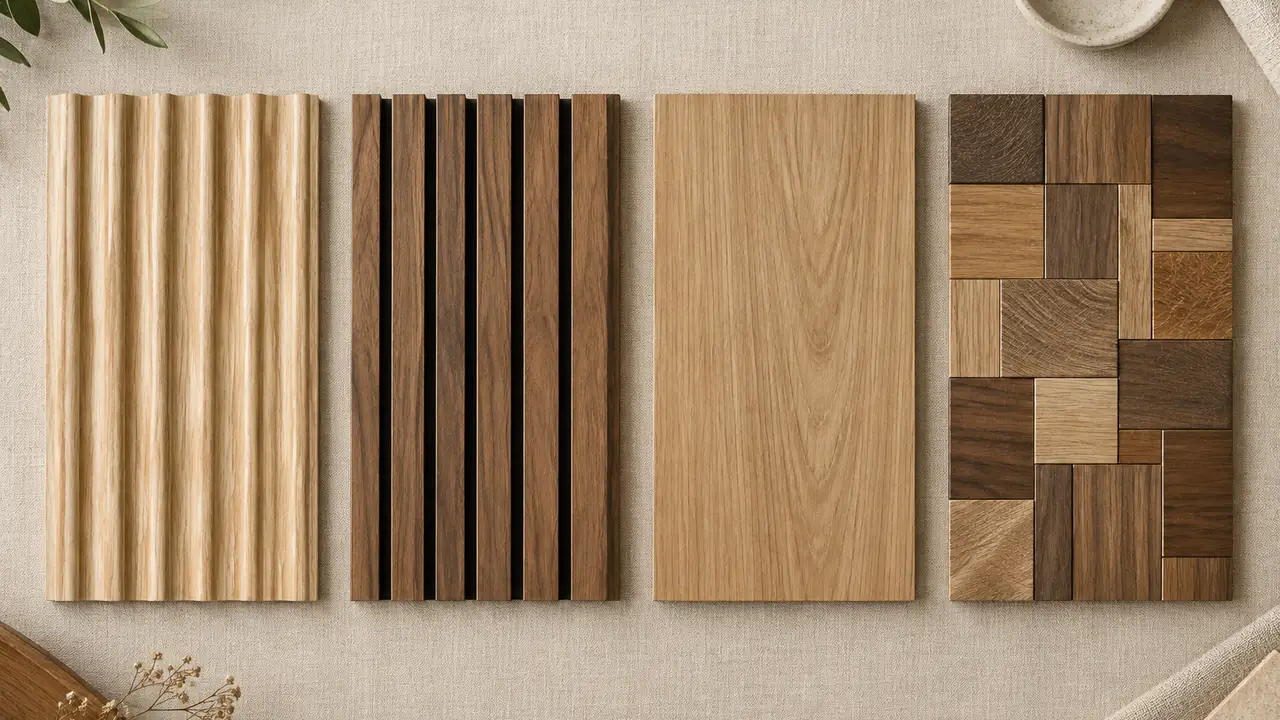
What a fluted panel actually is
A fluted wall panel is a machined profile product. The face of an engineered board - usually an MDF body - is routed into a continuous run of rounded flutes, finished in oak, walnut or black walnut tones through a veneer or a wrap, and in many builds the panel sits on a PET felt base that steadies the sandwich and takes the fixings. Typical ranges across the category, always confirmed on the spec sheet of the lot: panel widths of 120-160 mm, lengths of 2400-2900 mm, overall thickness of 12-22 mm, strip widths of 12-30 mm and gaps of 15-40 mm. Those five lines are the geometry of the product, and each one is a lever a brand can pull to differentiate a range rather than resell a commodity.
It helps to be clear about what the product is not. A fluted panel is a look product first: the rhythm is the value, and any absorption belongs to the felt behind it rather than to the flutes themselves. Brands whose brief names meeting rooms or corridor echo move to the acoustic slat family, which this desk sources as its own line; brands whose brief names feature walls, reception backdrops and headboard walls stay here. The fluted versus slatted note separates the two names section by section, and it is worth ten minutes before any sampling request goes out.
The layers that decide quality
Two fluted panels can share a listing photograph and not share a supply chain. The differences sit in the layers, and a brand buyer should walk them in order before comparing quotations.
| Layer | What to look at | Where quality quietly fails |
|---|---|---|
| Face finish | Species and tone of the veneer or wrap; each lot checked against a retained swatch | Wrap bridging across flute valleys; color drift between lots |
| Body | MDF grade and density; moisture-resistant option for humid rooms | Soft edges, telegraphed battens, seasonal movement |
| Felt base | PET thickness; bond line quality; how fixings bite | Delamination where felt meets body |
| Edges and ends | Banding and matching trims for cuts and corners | Raw cuts at sockets read as patchwork |
| Packaging | Corner protection, carton counts, crate order | Crushed corners arrive before complaints do |
The last two layers are the ones first-time importers skip, and they are the two that generate the most after-sales messages. Edge planning belongs in the original order - end caps, starter trims and corner pieces counted as line items - and packaging should be specified, not assumed, because a fluted profile shows every crushed corner on the wall.
Spec lines to lock before sampling
Geometry comes first, and it is worth writing down rather than describing on a call: strip width and gap, which together set the pitch that repeats across the wall; panel width and length, which decide how joints land on the drawing; and overall thickness, which moves weight, container fill and the span between battens. A change of a few millimeters in pitch changes the look of a finished wall more than most buyers expect, and it changes tooling on the plant side, so lock it before the first sample, not after.
Finish and color come second. Catalog tones in the oak, walnut and black walnut families start from a proven formula and a retained swatch; a custom tone adds a proofing cycle - commonly 15-25 days for the sample - and a longer first production run. The trade is identity against schedule, and the catalog versus custom note frames it for range planning. Either way, ask that the approved color be frozen as the retained swatch every future lot is checked against; that single habit is what keeps a year-three repeat order on-brand.
Grades, reports and claim discipline
Three document families belong in a fluted panel listing, and none of them belong to a sourcing desk - they belong to partner plants and production lots, verified per project. Emissions: composite cores ship under third-party certification aligned with EPA TSCA Title VI and CARB Phase 2 for the United States, or E0/E1 wording under GB/T 39600 for markets that read it; the formaldehyde grades guide lines the frameworks up side by side. Fire: where a market or a project brief asks, request a class per test report - ASTM E84 in North America, EN 13501-1 in Europe - for the tested build-up, never a blanket adjective; the fire rating guide shows how to ask. Acoustics: if a listing carries an absorption figure, that figure should come from a test report on the felted build being shipped; if there is no felt and no report, keep acoustic wording out of the listing altogether.
Quantities, samples and lead time
Reference quantities keep a program honest. Across the category, fluted and other veneered lines commonly start around 100-300 sq m per color, confirmed in writing for each program; the desk publishes the typical ranges on the MOQ and lead time page rather than improvising a number per email. Sampling runs in stages: color card books in roughly 5-10 working days, full panel samples in roughly 7-15 working days, custom color proofing in roughly 15-25 days. Bulk production for veneered lines typically runs 25-45 days, longer for a first custom-color order, and a 40-foot high-cube container carries roughly 800-1,200 sq m depending on thickness and packaging style. Treat all of it as planning ranges - the written confirmation per program is the number that counts.
What to ask a partner plant
- Which pitches and formats run on existing tooling, and which require new cutters - and how that tooling is accounted for.
- What the retained swatch discipline is: who keeps it, how lots are checked, and under what lighting.
- Which emission certificate the core carries per lot, and whether the certifier is recognized in the destination market.
- How wrap adhesion into the flute valley is checked, and what the adhesion test record looks like.
- What fire documentation exists for the build being quoted, per test report, if the listing or the project needs it.
- How cartons are counted, corner-protected and crated, and whether crate order can mirror install order.
- What the written confirmation covers: area per color, lead time, document package, and the repeat-order lane.
How the desk runs a fluted program
A fluted program through this desk moves in the same stages as any panel line. The brief fixes family, market and the certificates the listing will name. The desk shortlists two or three partner plants by color family, orders color cards, then panel samples checked against the retained swatch under a standard lamp. The approved color is frozen; production runs per color; inspection follows the plan agreed before the first sheet was made; and the crate list is built so the first panels off the container are the ones the installer needs first. After-sales is planned before shipment - spare panels per color for installer errors, and a repeat-order lane so the second lot lands on the same swatch. The stage-by-stage version, with who does what, lives on the sourcing process page.
When the spec lines above are drafted - pitch, formats, thickness, color ladder, certificates - the quote form puts the whole brief in front of the shortlisted plants at once, and the desk returns options with the ranges each plant documents best. That comparison, like for like on the same spec lines, is the entire value of sourcing a fluted line through a desk rather than through a listing.