
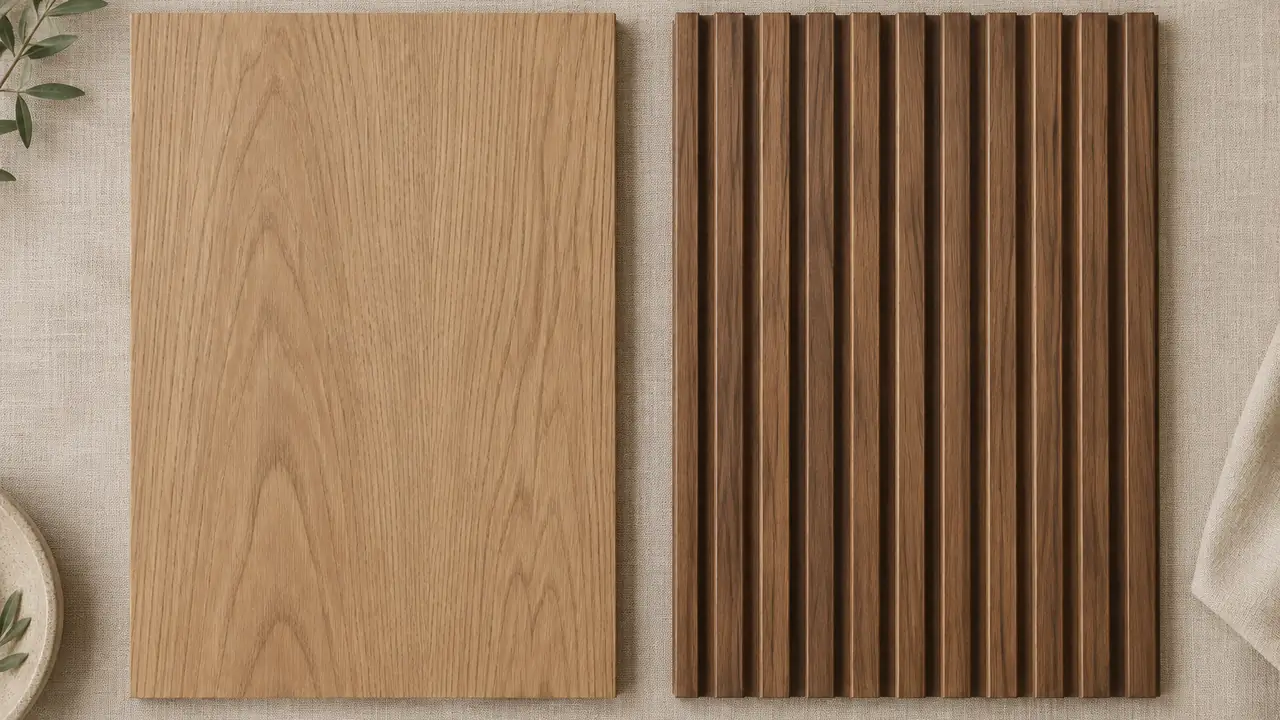
Why the comparison matters at brief stage
Listings blur veneer and laminate into one impression of wood-look wall, and the blur costs programs real money in the wrong direction: a brand that needs a grain story orders printed surface by mistake, or a high-traffic fit-out pays for matching labor it did not need. The two constructions answer different briefs, and the difference is not a quality ranking - both are legitimate wall surfaces with distinct strengths. What a buyer should understand before sampling is where the material truth of each one lies, how batches behave, and which cost drivers each construction accepts. Both ride on the same families of cores and adhesives, and both can carry the same emission certificates, which is why this is a surface decision rather than a compliance one.
The frame below treats each surface as it is actually made, then compares them line by line and closes with where each wins and what belongs on the specification.
What a veneer surface is
Veneer is real wood, sliced at roughly 0.3-0.6 mm and laid onto a core of MDF or plywood, most often in the standard 1220 x 2440 mm sheet format at 3-18 mm thickness per spec sheet. Natural veneer carries knots, mineral lines and grain drift - a story, not a pattern. Engineered veneer, reconstituted from real wood and dyed to consistent tones, repeats predictably across batches, which is why multi-phase programs favor it. The craft layer is matching: book, slip or random, per the matching note, so a reception wall reads as one composition rather than forty separate panels. Edges receive banding or solid lipping from the same ladder - the trim note covers the options - and the finished surface takes oil or lacquer the way furniture does, which is where the tactile reputation comes from.
What a laminate surface is
A laminate is not sliced wood. It is a decorative paper or film, printed with a wood-look pattern - sometimes with registered embossing that follows the print - consolidated with resins and pressed onto the core under heat and pressure. Because the pattern is printed, consistency is the strength: every panel in a batch shows the same grain, and the forty-first panel matches the first without a matching plan, a retained swatch or a sampling cycle. Wear behavior comes from the overlay and resin load rather than from the hardness of any wood. The trade is depth: under a hand and raking light, a laminate reads as a manufactured surface, however good the print, and edges need banding from the same line to finish convincingly.
The two surfaces side by side
| Aspect | Veneer panel | Laminate panel |
|---|---|---|
| Face material | Sliced real wood, 0.3-0.6 mm | Printed paper or film with resin |
| Grain across a wall | Book-matched continuity; natural drift or engineered repeat | Identical print on every panel |
| Feel and light | Open grain, furniture-grade depth under finish | Uniform; embossing supplies texture |
| Batch behavior | Managed with retained swatch and matching plan | Stable print to print |
| Edges | Banding or lipping in the same species ladder | Matching banding from the line |
| Cost drivers | Species rarity, matching labor, core grade | Print tooling, resin load, press cycle |
| Certification route | Core and adhesive: E0/E1 or CARB P2 per certificate | Same route - core and bond line carry the grade |
| Strongest fit | Brand walls, lobbies, joinery-matched programs | High-wear retail, rental and repeatable fit-outs |
Ranges in the table are typical across the category; the spec sheet of the actual build is the authority, and both surfaces can sit on moisture-resistant cores where the destination room asks for it.
Cost drivers, in both directions
Veneer concentrates cost in the face: species rarity, the matching method chosen, and the labor of clipping and jointing leaves into faces before pressing. Thickness and core grade add their tiers, and a custom stained tone adds a proofing cycle. Laminate concentrates cost in the making: print cylinders or film stock, resin load, press time and the embossing register. That is why laminate rewards volume and repetition - tooling amortizes across long runs - while veneer rewards programs that will pay for material identity once and reuse the approved swatch for years. A fair comparison quotes like for like: same core, same thickness, same edge treatment, same emission grade. Otherwise the exercise compares two different products wearing one name, and the cheaper number usually hides a different build.
The certification route is shared
Whichever surface sits on top, the emission grade is a property of the core and the adhesive: E0/E1 under GB/T 39600 for markets that read the Chinese and European frames, or CARB Phase 2 alignment with EPA TSCA Title VI for the United States, certified by approved third parties and documented per lot. The grades guide lines the tiers up side by side. Fire classes, where a listing names one, belong to the tested build-up - face included - under ASTM E84 or EN 13501-1, stated per test report. Neither surface changes what a certificate can say by its name alone; the documents do the talking, and the desk verifies them for the lot being shipped, never for the brochure.
When each wins, and what to specify
Veneer wins where the wall is the brand statement: lobbies, reception walls, wardrobe fronts and retail backdrops that must match joinery in the same room, plus any program where a grain story at scale justifies one sampling cycle. Laminate wins where repetition and wear dominate: high-traffic retail, rental programs, hospitality back-of-house and ranges built on print-to-print predictability. Many catalogs carry both, separated by application logic - veneer at eye level and brand walls, laminate in wear zones - rather than by any ranking between them.
Reference quantities stay as the category's typical ranges: veneer panel lines commonly start around 100-300 sq m per color, and veneer sheets from 500 sq m per color for programs that face their own cores, always confirmed in writing per program on the MOQ and lead time page. The veneer sheets line serves buyers who laminate or press in-house; the finished route begins on the panel page, and the types guide places both surfaces among the other families. For a like-for-like quotation across two or three partner plants, the quote form takes core, thickness, surface, edges and certificates in one brief.