
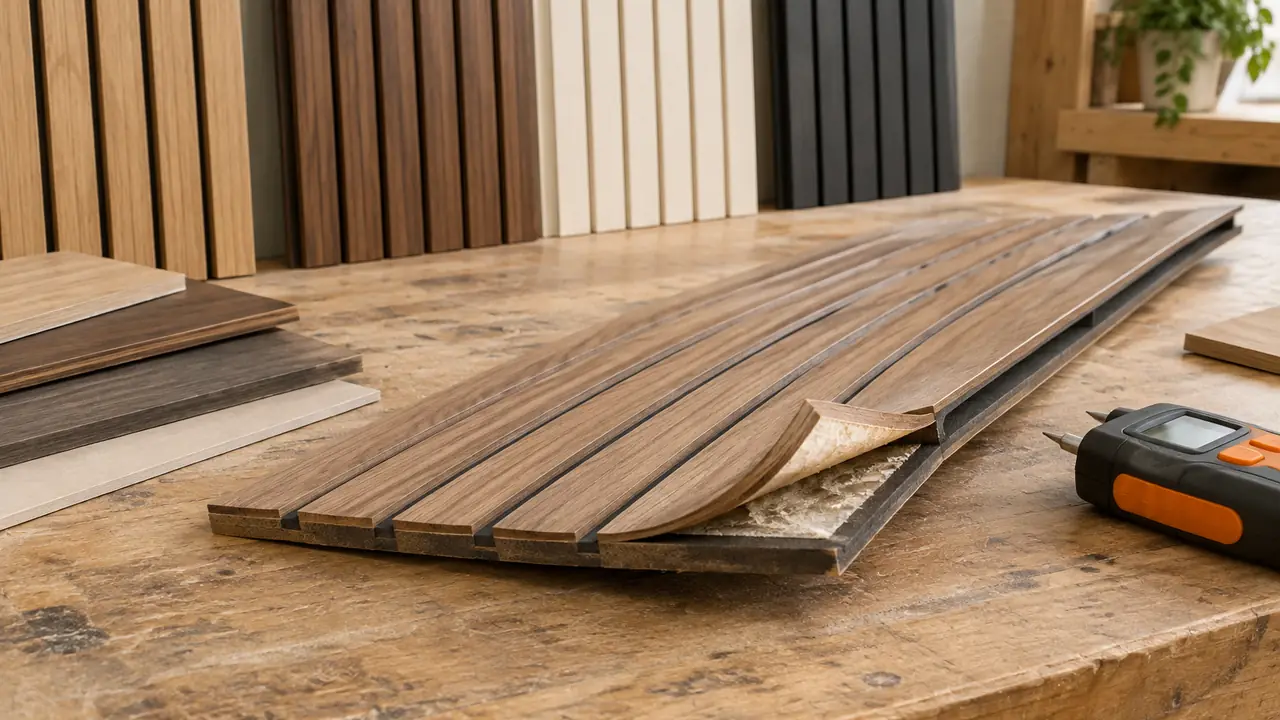
Edges fail first because they carry every load
Physics gives the edge no protection. When a carton is set down hard, the energy arrives at corners; when a panel slides, the front edge meets the obstacle; when a stack shifts, the weakest point of contact is an edge. An engineered panel made of MDF or a similar dense core has a particular weakness here: the core is strong in compression but comparatively brittle at thin sections, so a knock that a solid timber edge would shrug off can open a crisp, clean chip in an engineered one - which is precisely why the damage looks so sharp in photographs.
The commercial asymmetry is worse than the physical one. A chip in the middle of a panel face might hide behind furniture; a chip on a corner or along a visible edge is the first thing the eye lands on, at any install height. It is also the defect category most likely to survive to a customer review, because unlike a bond failure that appears months later, a chip is visible the day the carton opens, in front of the person already primed to judge. Everything below follows from that asymmetry: edge protection earns its cost many times over, and the prevention list is short enough to write into any order.
First cause: handling, everywhere in the chain
The most frequent origin is simply handling - and the panel is handled a dozen times between press and wall: into cartons, cartons onto pallets, pallets into containers, containers across two or three transfer points, warehouse to van, van to site, site to wall. Each transfer is a chance for a corner, and statistically a container program multiplies those chances by thousands of panels. This is why chipping rates correlate more with route complexity than with plant quality: a direct FCL load to one warehouse damages less than a deconsolidated LCL route through two terminals, on the same panels in the same cartons.
A brand cannot eliminate handling, but it can price it in and design for it. Route choice is a specification decision - the logistics page frames the trade-offs - and carton design absorbs the remainder: the difference between a bare corner and a guarded one is measured in fractions of a centimeter of board and shows up as whole panels saved. The packaging components note itemizes the parts: corner guards, edge protectors, interleaf sheets, void fill, the unglamorous heroes of the category.
Second cause: packaging that protects faces, not edges
Second is a specific and common packaging failure: designs that cushion faces and neglect edges. Foam sheets between panel faces prevent scratching; they do nothing when a pallet is set down and the whole stack's inertia arrives at the bottom cartons' corners. Effective panel packaging is edge-led: corner guards on every vertical corner, edge protectors under strapping so bands never bite a panel directly, interleaf so panels do not vibrate against each other, and a fill discipline that stops cartons from shifting inside the case. None of it is expensive relative to the product it protects; all of it must be specified, because a plant packing to its own defaults will optimize for speed.
| Stage | Typical damage | Countermeasure | Check that verifies it |
|---|---|---|---|
| Plant load-out | Corners scuffed pulling cartons across floors | Corner guards; carton design with edge stands | Packaging check against the crate plan |
| Transit transfers | Stacks shifted; band-bite on edges | Edge protectors under strapping; void fill discipline | Carton open inspection per container |
| Warehouse | Bottom-carton crush under tall stacks | Stack height limits on the crate plan; flat bearers | Storage guidance in the program file |
| Site cutting | Chips at saw cuts and drilled holes | Install sheet: score cuts, support offcuts, sharp tooling | Installer acknowledgment |
| Install | Tool strikes at sockets and corners | Matching trim and end caps to absorb transitions | Trim counts planned from the drawing |
Third and fourth: site cutting and banding quality
Third in frequency is cutting on site, which is where a program's quality reputation can be undone by someone else's tools. MDF edges chip when saw teeth exit the cut unsupported or blunt; the install sheet's prevention lines are short - score the cut line, support the offcut, use sharp fine-tooth blades, drill with backing - and they belong there explicitly, because installers improvise by default. Where the drawing allows, planning layouts so visible cut edges land under trims converts the problem into a detail: the installation systems guide and the trim line both support that planning.
Fourth is edge banding quality on flat panels. Banding that peels at a corner was usually applied with thin adhesive coverage or trimmed proud and stressed; once a band edge lifts, the exposed core chips easily and the panel looks damaged even where it is not. Banding adhesion is a normal item in the adhesion checks the testing and inspection page organizes, and it is worth sampling in every lot that ships banded product - a corner-lift caught at inspection is a packing note, while one caught by a customer is a return.
What chipping risk means for a brand
Chipping is the most common driver of single-panel returns in boxed panel programs, and returns of one panel out of a carton set are the most uneconomic claims in the category: freight and handling swamp the product cost. Three program levers reduce the rate. First, packaging specification - edge-led design as above, agreed in writing, checked at loading. Second, spare ratio and trims - a modest overage of panels and a count of matching trims per drawing, so a chipped corner becomes a local repair with a color-matched end cap instead of a full-panel return. Third, retail-box design where panels ship as consumer units: reinforced corners, handling icons, and a carton that survives a courier network, all covered on the packaging and retail boxes page.
Claims handling completes the picture. A program that photographs cartons at loading, opens and inspects sample cartons at receipt, and files damage evidence within the carrier's window recovers costs that casual programs write off - the evidence protocol is laid out in the shipping damage note. The pattern across all three levers is the same: the chip is the symptom, and the specification is the prevention.
Specification and inspection: the edge ledger
Closing lines for the order file. Specification: edge banding on all exposed edges with the banding material named, corner guards and edge protectors in the packaging spec, stack heights and bearer rules in the crate plan, trim counts from the drawing, and a cutting-and-handling page in the install sheet. Inspection: packaging verified against the crate plan at loading, carton-open sampling at receipt, banding adhesion sampled per lot, damage evidence protocol agreed with the carrier window written down. An edge ledger like this does not make panels unbreakable - it makes breaks rare, visible early, and somebody's documented job rather than everybody's surprise.
The desk builds the ledger into panel programs as standard: reference quantities and timing on the MOQ and lead time page, and the quote form captures packaging tier, retail-box needs and trim counts alongside color and area in one message.